Infection of the small intestine by type C strains of Clostridium perfringens causes a highly fatal, necrohemorrhagic enteritis. This bacterium is trypsin-sensitive; thus, disease is common in neonates with low trypsin levels. It most commonly affects piglets 1–5 days old; however, in rare cases infection occurs in pigs up to 21 days old and in other species. Diagnosis is via a combination of lesion assessment and bacterial isolation and typing.
Etiology and Pathogenesis of C perfringens Type C Enteritis in Pigs
C perfringens proliferates rapidly in the intestinal contents and elaborates beta toxin, a potent, heat-labile, trypsin-sensitive exotoxin that causes necrosis of all structural components of the villi. Necrotizing inflammation usually extends to the mucosal crypts. The infection may continue caudally and involve the ileum; however, it rarely affects the colon. Necrosis of the mucosa is accompanied by blood loss into the intestinal wall and lumen.
Clinical Findings of C perfringens Type C Enteritis in Pigs
Sudden onset of hemorrhagic diarrhea followed by collapse and death is characteristic of Clostridium perfringens type C enteritis in piglets 1–3 days old. Entire litters are typically affected, and mortality rate is close to 100%. In less severe cases, brownish liquid feces develop at 3–5 days old. Infrequently, pigs develop a persistent, pasty-gray diarrhea and become progressively emaciated.
Lesions of C perfringens Type C Enteritis in Pigs
The small intestines of affected piglets are dark red, hemorrhagic, and filled with bloody fluid (see ). At 3–5 days, less severe cases might have emphysema in the wall of the jejunum and necrosis of the mucosa of the jejunum and ileum. More chronic cases have a thickened small intestine lined by a pale yellow or gray necrotic membrane that adheres tightly to the submucosa. Microscopically, there is segmental hemorrhagic necrosis affecting the entire mucosa. Characteristic thick bacilli with square ends that lack spores are commonly observed along necrotic villi and within the intestinal lumen.

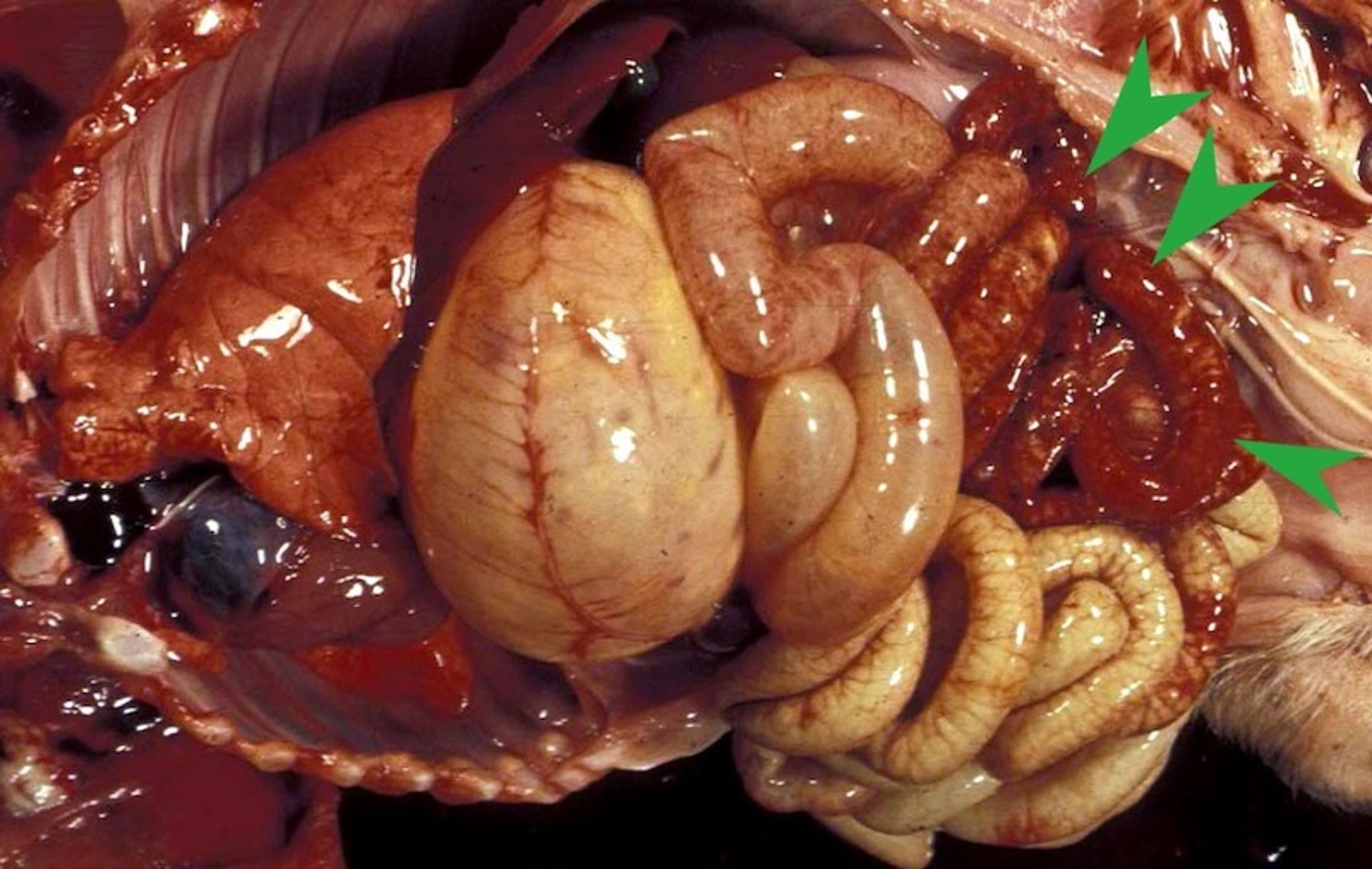
Necropsy photograph of Clostridium perfringens type C subacute enteritis in a pig, characterized by segmental necrosis and hemorrhage in the jejunum (indicated by green arrowheads).
Courtesy of Iowa State University Veterinary Diagnostic Laboratory.
Diagnosis of C perfringens Type C Enteritis in Pigs
Clinical signs and lesions in suckling pigs
Detection of beta toxin in feces or via culture and genotyping
Postmortem examination is usually sufficient to establish diagnosis of the peracute hemorrhagic form of C perfringens type C enteritis and of the peracute form with jejunal emphysema. A rapid presumptive diagnosis can be made by seeing large, rod-shaped bacteria in Gram-stained mucosal impression smears (see ). Histological demonstration of villous necrosis with mucosal colonization by numerous large, gram-positive rods is adequate for confirmation (see ).

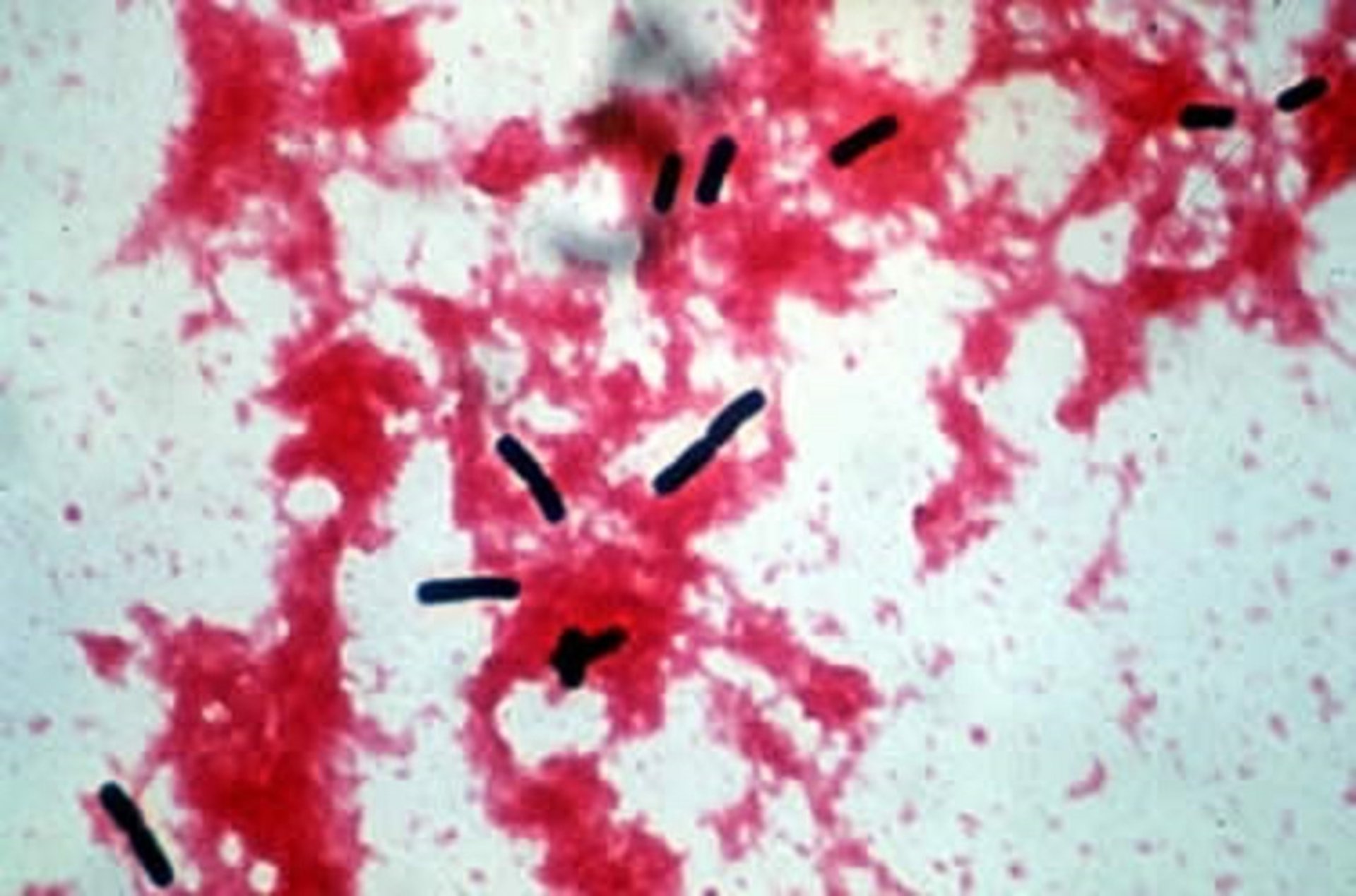
High-power photomicrograph of Clostridium perfringens in a Gram-stained smear from the intestinal epithelial surface of a pig. Note the characteristic intensely gram-positive large rods and their lack of spores.
Courtesy of Dr. John Prescott.


Clostridium perfringens type C enteritis in a piglet. Note the necrotic jejunal villi with a myriad of associated bacteria of mixed morphology (indicated by arrowheads), including many large rods typical of C perfringens. H&E stain; scale bar = 200 mcm.
Courtesy of Dr. Eric R. Burrough.
Subacute and chronic forms of the disease in piglets 6–14 days old are easily confused with Cystoisospora suis enteritis at postmortem examination; however, diagnosis is usually possible via histological examination of the jejunum and ileum or by observation of clostridia in mucosal smears (Gram or Giemsa stain). Isolates of C perfringens may be genotyped for the presence of genes that encode for beta toxin.
Treatment and Control of C perfringens Type C Enteritis in Pigs
Vaccination to improve maternal immunity on sow farms
Antitoxin administration
Treatment of pigs with clinical signs of Clostridium perfringens type C enteritis is of little benefit because lesions usually are irreversible at the onset of diarrhea. In an acute outbreak, prophylactic administration of type C antitoxin or antimicrobial (or both) parenterally or orally is protective if given to piglets within 2 hours of birth. C perfringens type C enteritis tends to recur on infected premises.
Vaccination of gestating sows at 6 and 3 weeks before parturition with type C bacterin-toxoid confers some passive lactogenic immunity if piglets consume colostrum soon after birth. Naive gilts could benefit from three vaccinations before their first farrowing to ensure sufficient colostral antibodies. Once properly immunized, sows should receive one dose approximately 3 weeks before each subsequent farrowing.
Key Points
Clostridium perfringens type C toxin is trypsin-sensitive; thus, disease is common in neonates with low trypsin levels.
Death of entire litters is common.
Epidemics can occur when the organism is introduced into naive herds.
For More Information
Richard OK, Grahofer A, Nathues H, Posthaus H. Vaccination against Clostridium perfringens type C enteritis in pigs: a field study using an adapted vaccination schedule. Porcine Health Manag. 2019;5:20. doi:10.1186/s40813-019-0127-8
Uzal FA, Navarro MA, Asin J. Clostridia. In Zimmerman JJ, Burrough ER, Karriker LA, Schwartz KJ, Zhang J, eds. Diseases of Swine. 12th ed. John Wiley and Sons, Inc; 2026:929-945.