Intestinal spirochetosis is a disease that commonly manifests as mucoid diarrhea in grower-finisher pigs and is limited to the large intestine. Disease is considerably less severe than what is observed with swine dysentery and caused by spirochetes of the same genus. Intestinal spirochetosis is reported worldwide.
Etiology and Pathogenesis of Intestinal Spirochetosis in Pigs
The etiological agent of intestinal spirochetosis is Brachyspira pilosicoli. B pilosicoliis an important pathogen of humans, especially in indigenous populations and immunosuppressed patients. The organism is transmitted orally and survives extremely well in the environment.
B pilosicoli has been isolated from a wide variety of animals, including water birds, rodents, and dogs. It has been shown to cause diarrheal disease in pigs, chickens, and humans by experimental inoculation and natural occurrence; however, the pathogenesis is not well studied. As with swine dysentery, B pilosicoli colonization and disease expression can be appreciably influenced by alteration of dietary fiber.
Clinical Findings of Intestinal Spirochetosis in Pigs
Clinical signs of intestinal spirochetosis typically occur in 8- to 12-week-old pigs and often occur 1–2 weeks after movement or commingling. Feces from affected pigs appear similar to wet cement, and this mild diarrhea commonly lasts for 3–6 weeks. Uncomplicated disease is not usually associated with elevated death rates; however, pigs may have decreased appetite and grow slowly, causing economic losses.
Lesions of Intestinal Spirochetosis in Pigs
The lesions in the large intestine with intestinal spirochetosis are milder than those caused by Brachyspira hyodysenteriae in swine dysentery. The volume of the large intestine may be increased with thickening of the mucosa. In some pigs, copious catarrhal colitis develops in association with enlarged colonic lymph nodes. Microscopically, spirochetes can be observed attached end-on to the mucosal surface, giving the appearance of a false brush border; however, this lesion is inconsistent and most often occurs early in the course of disease. The mucosal surface may have focal erosions with associated catarrhal exudate. Colonic crypts are often dilated with mucus and can contain numerous spirochetes.
Diagnosis of Intestinal Spirochetosis in Pigs
Selective anaerobic culture for Brachyspira
Histological evaluation
The differential diagnosis of intestinal spirochetosis often includes intestinal salmonellosis, proliferative enteropathy, swine dysentery, and whipworm infection. B pilosicoli and other Brachyspira spp can be isolated on selective agar under anaerobic conditions.
Biochemical tests have historically been used for species identification; however, PCR assays, sequencing, and mass spectrometry are increasingly available and more consistent. PCR assays for B pilosicoli that can be applied directly to fecal samples are also available. Histological evaluation with silver stains is useful to identify end-on attached bacteria and to exclude other disease conditions (see ).

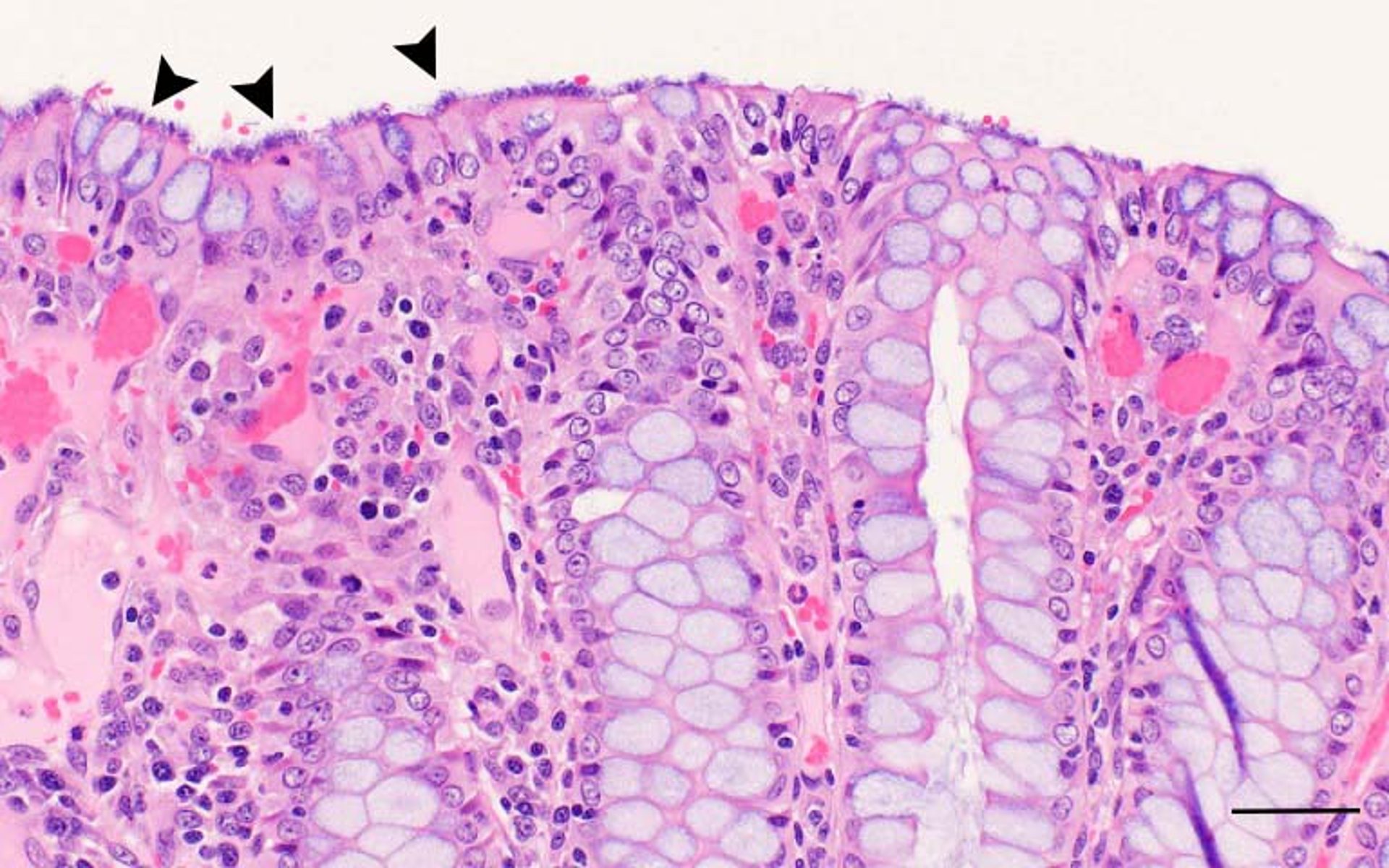
Photomicrograph showing intestinal spirochetosis in a pig. Note the numerous end-on attached spirochetes (arrowheads) lining the luminal surface of the colonic mucosa. H&E stain; scale bar = 50 mcm.
Courtesy of Dr. Eric R. Burrough.
Treatment and Control of Intestinal Spirochetosis in Pigs
Antimicrobials
Minimizing exposure to reservoir hosts
Treatment and prevention of intestinal spirochetosis are similar to those of swine dysentery. Administration of drugs such as tiamulin, lincomycin, and tylosin has historically been effective; however, increasing antimicrobial resistance has been reported in several countries, and minimum inhibitory concentration testing is recommended before beginning treatment. It is unknown whether the agent can be eradicated without total depopulation, as can be done with swine dysentery; however, given the number of potential reservoir hosts and environmental survival, eradication seems unlikely.
Key Points
Disease is limited to the colon and is milder than swine dysentery.
Culture and PCR assays are available for species identification.
Resistance to commonly used antimicrobials is increasing.
For More Information
Hampson DJ. The spirochete Brachyspira pilosicoli, enteric pathogen of animals and humans. Clin Microbiol Rev. 2017;31(1):e00087-17.
Hampson DJ, Burrough ER, Costa MO. Brachyspira spp. In: Zimmerman JJ, Burrough ER, Karriker LA, Schwartz KJ, Zhang J, eds. Diseases of Swine. 12th ed. John Wiley and Sons, Inc; 2026:891-911.