In horses, which have a hypsodont dentition (long-crowned teeth that continue to erupt throughout life), age is best estimated by the eruption times and additionally can be indicated by gross changes of the lower incisors over time. In species such as dogs and cats with brachydont dentition (short-crowned teeth), age determination is less accurate and is based mostly on dental eruption times and, subjectively, on evaluation of root canal width as noted on dental imaging (see the table ).
Estimation of age by teeth is used in determining useful working life, when purchasing an animal, for insurance purposes, to help identify an animal, and to determine the prognosis of disease.
Eruption of the Teeth a
Tooth | Horse | Cow | Sheep and Goat | Pig | Dog | Cat |
|---|---|---|---|---|---|---|
Di1 | 0–1 wk | Before birth | 0–1 wk | 3–4 wk | 4–5 wk | 2–3 wk |
Di2 | 4–6 wk | Before birth | 1–2 wk | 2–3 mo | 4–5 wk | 3–4 wk |
Di3 | 6–9 mo | 0–1 wk | 2–3 wk | Before birth | 3–4 wk | 3–4 wk |
I1 | 2½ yr | 2 yr | 1–1½ yr | 12–15 mo | 4 mo | 4–7 mo |
I2 | 3½ yr | 2½ yr | 1½–2 yr | 16–20 mo | 4½ mo | 4–7 mo |
I3 | 4½ yr | 3½ yr | 2–2½ yrb | 8–10 mo | 5 mo | 4–7 mo |
Dc | Does not erupt | 0–2 wk | 3–4 wk | Before birth | 3–4 wk | 3–4 wk |
C | 4–5 yr | 3½–4 yr | 2½–4 yrc | 6–10 mo | 5–6 mo | 4–7 mo |
Dp2 | 0–2 wk | 0–3 wk | 0–4 wk | 4–6 wk | 4–6 wk | 5–6 wk (upper only) |
Dp3 | 0–2 wk | 0–3 wk | 0–4 wk | 1½ mo | 4–6 wk | 5–6 wk |
Dp4 | 0–2 wk | 0–3 wk | 0–4 wk | 1–5 wk | 4–6 wk | 5–6 wk |
P1 | 5–6 mo (wolf tooth) | — | — | 5 mo | 4–5 mo | — |
P2 | 2½ yr | 2–2½ yr | 1½–2 yr | 12–15 mo | 5–6 mo | 4–7 mo (upper only) |
P3 | 3 yr | 2–2½ yr | 1½–2 yr | 12–15 mo | 5–6 mo | 4–7 mo |
P4 | 4 yr | 2½–3 yr | 1½–2 yr | 12–15 mo | 5–6 mo | 4–7 mo |
M1 | 9–12 mo | 5–6 mo | 3–6 mod | 4–6 mo | 4–5 mo | 4–7 mo |
M2 | 2 yr | 1–1½ yr | 9–12 mo | 8–12 mo | 5–6 mo | — |
M3 | 4 yr | 2–2½ yr | 1½–2 yr | 18–20 mo | 6–7 mo | — |
a Average data, subject to considerable variation | ||||||
b 2 years in goats | ||||||
c 2½–3 years in goats | ||||||
d 3–4 months in sheep | ||||||
Estimation of Age by Dentition in Horses
In horses, which have hypsodont dentition (characterized by reserve crown length with continual eruption), relative increase in the height of the teeth makes up for occlusal wear, which occurs at a rate of approximately 2.5 mm/year until approximately 17 years of age (1). Aging horses by teeth is most accurate during known eruption periods of deciduous and permanent dentition.
Tooth morphology differs between the deciduous and permanent dentition. The deciduous incisors are smaller than the permanent ones, and the surfaces of their crowns are whiter and have several small longitudinal ridges and grooves. Permanent incisors are larger and more rectangular in shape. For eruption times, see the table .
Eruption of permanent dentition is typically complete by 5 years of age, after which aging horses by teeth is subject to inaccuracy related to influences of malocclusion, odontoplasty (dental floating), husbandry practices, and individual or breed variations. The lower incisors are used most commonly to attempt to age a horse with permanent dentition. Continued eruption and occlusal wear of incisors leads to gross occlusal changes in the appearance of infundibulae, enamel, and secondary dentin.
Specific anatomical components evaluated grossly at the occlusal surface of incisors are the infundibulae and the pulp horns. The incisor infundibulae (see ) are located lingual to the pulp horn and are made up of enamel as the peripheral layer and cementum at the center. They are often incompletely filled with cementum and can appear dark or be filled with feed material. The pulp horns are denoted by dark-staining secondary dentin.


Schematic of the dentition of a horse (Equus caballus). Illustrated are the anatomical features of particular teeth as well as the variations observed on the occlusal surfaces of the different types of teeth and as a function of age.
Illustration by Dr. Gheorghe Constantinescu.
"Dental star" is a colloquial term used to identify the pulp horn. "Dental cup" and "Enamel cup" are colloquial terms used to identify the infundibulum. Both of these anatomical components will exhibit shape changes as the tooth continues to erupt and wear along the length of the crown (see ).
Equine incisor teeth develop certain wear-related macroscopic features that have historically been used to estimate age. The dental star consists of yellowish-brown secondary dentin produced by the odontoblasts of the pulp horn at the occlusal surface as the tooth wears. Its shape and position, as well as the appearance of the white spot in its center, are related to age and anatomy.
The shape, size, and time of disappearance of the infundibulae or "cups" (funnel-like infoldings in the occlusal surface) are additional, more variable indicators of age. Progressive dental wear causes an alteration of the occlusal shape of the incisors. The occlusal surfaces of incisors when they erupt are elliptical; with age, however, they subsequently become trapezoid, round, and then triangular, with the apex toward the lingual side.

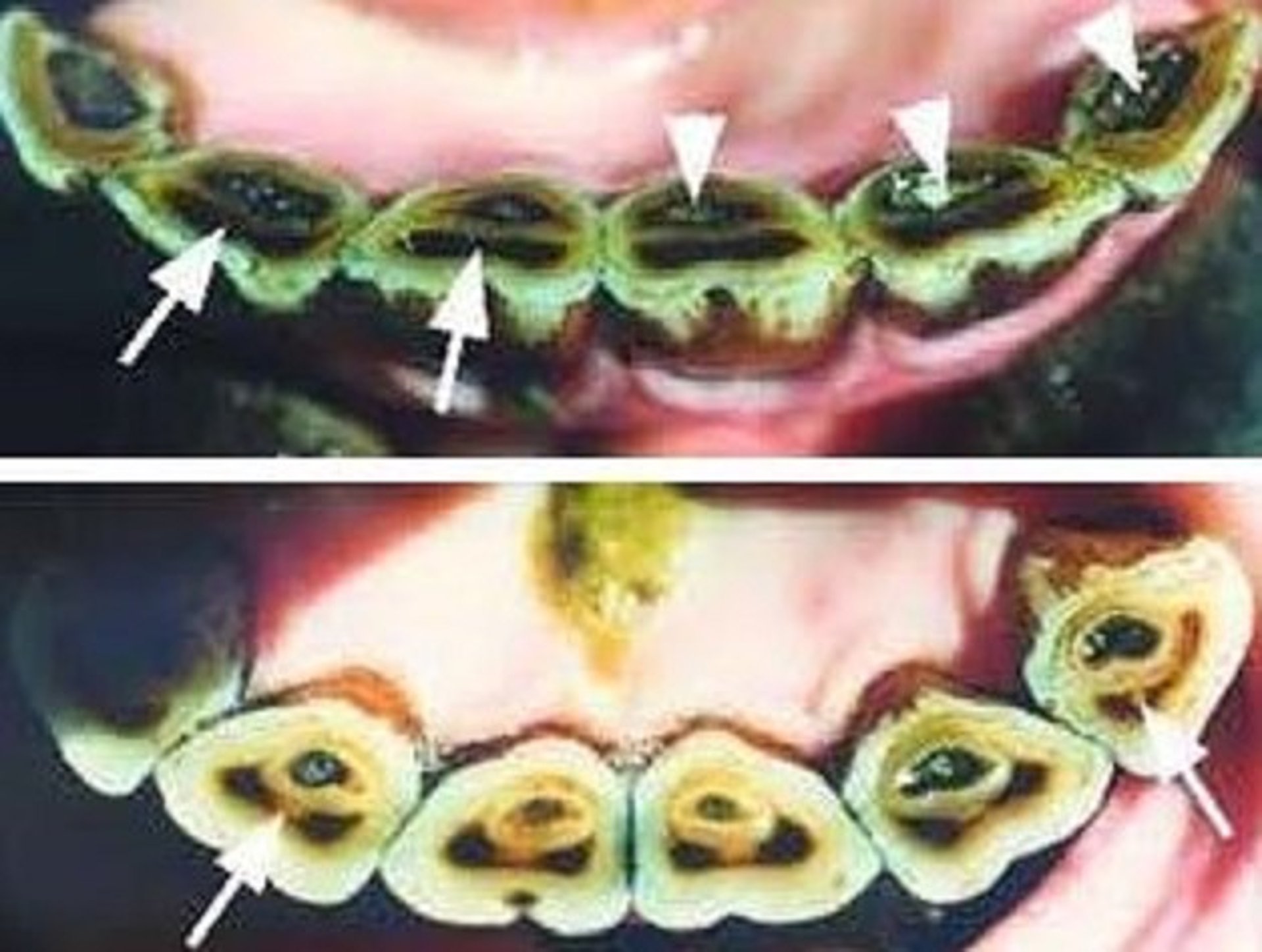
Top: Occlusal view of the lower incisors of a 6-year-old mare. Dental stars (pulp horns) are visible on I1 and I2 (arrows); dental cups (infundibulae) are present as large elliptical infoldings (arrowheads). They are dark stained/filled with feed because of incomplete formation of cementum during development. Occlusal surfaces of the incisors are typically described as oval at this younger age, and curvature of the dental arch is described as semicircular.
Bottom: Occlusal view of the lower incisors of a 12-year-old mare. In the center of the dental stars, a white spot is clearly visible (arrows), which is typical when there are two pulp horns. The dental cups have become smaller and shallower. The infundibulum does not occupy the entire length of the incisor crown. Eventually, with continued eruption and wear, the area where a dental cup used to be will be described as an "enamel spot," the colloquial term for the end of the infundibulum. The occlusal surfaces are typically described as more triangular as the horse ages and the crown wears over time.
Courtesy of Dr. Sofie Muylle.
The curvature of the dental arch formed by the lower incisive tables is also age-related. In young horses, this arch is semicircular, whereas in older horses, it forms a straight line. Additionally, the arch formed by the incisors of the opposing jaws (as they meet) changes as the teeth advance from their alveoli and undergo attrition. In young horses, the upper and lower incisors are positioned in a straight line. With increasing age, the angle between upper and lower incisors becomes more acute.
Radiographic assessment of cheek teeth for root morphology in young horses can also aid in age determination, as the roots are mature and closed at 5-8 years old. However, in aged horses, radiographic signs of age are also subject to inaccuracy.
The Galvayne’s groove and the 7-year hook, which have historically been used as age indicators, are variable, inconsistent, and thus of little value for age determination in horses. The following clinical signs, arranged chronologically, are most useful in aging horses:
Birth to 5 years: See the table .
5 years: Corner incisors are erupting. A dental star is present on the central incisors.
6 years: A dental star is present on the middle incisors. The cups are gone from the maxillary central incisors.
7 years: A dental star is present on the corner incisors. The cups are gone from the maxillary second incisors.
8 years: The central incisors are trapezoidal. A white spot is present within the dental star. The cups are gone from the maxillary third incisors.
9 years: The middle incisors are trapezoidal. A white spot is present within the dental star. The cups are gone from the mandibular central incisors.
10 years: Enamel spots on the central incisors are oval-triangular. The cups are gone from the mandibular second incisors.
11 years: A white spot is present within the dental star on the corner incisors. Both central and middle incisors have a lingual apex. The corner incisors are triangular with a labial apex. The cups are gone from the mandibular third incisors.
12 years: The cups are gone from all incisors.
14 years: Enamel spots on the central and middle incisors are small and round.
18 years: Enamel spots have disappeared from the central incisors.
20 years: Enamel spots are gone from the middle incisors and the corner incisors.
Estimation of Age by Dentition in Cattle
Eruption times of incisors are the most reliable feature for age determination in cattle (see the table ). As cattle continue to age, the incisor teeth wear shorter, and more neck becomes visible; the teeth loosen in the sockets and eventually drop out. The premolars and molars continue to erupt to keep up with occlusal wear.

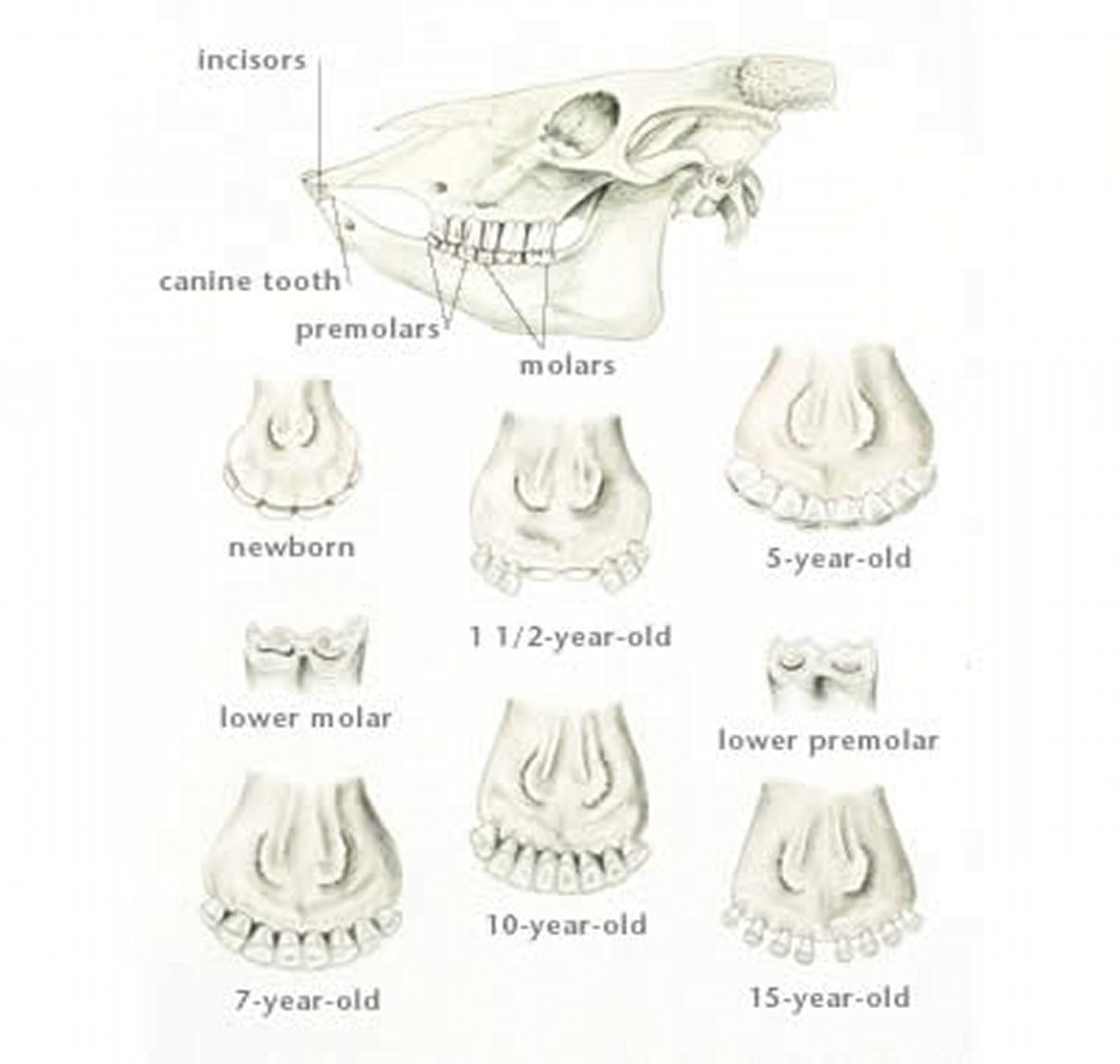
Schematic of the dentition of a large ruminant. Illustrated are the anatomical features of particular teeth as well as the variations observed on the occlusal surfaces of the different types of teeth and as a function of age.
Illustration by Dr. Gheorghe Constantinescu.
Although breed-related, eruption dates are more reliable for estimation of age than clinical signs of wear (see ), because macroscopic age-related dental features are scarce (dental stars) or absent (cups and spots) and because rate of wear is largely influenced by nutrition.
Estimation of Age by Dentition in Dogs
Patterns of dental wear in canine patients can vary greatly. Dogs with malocclusions leading to attrition as well as those with heavy chewing behaviors or those offered harder toys or treats (abrasion) will exhibit wear at a younger age.
As teeth mature and age, secondary dentin is deposited via odontoblasts in the pulp cavity and mineralized. This process appears as narrowing of the pulp canal on intraoral radiographs over time (see ).

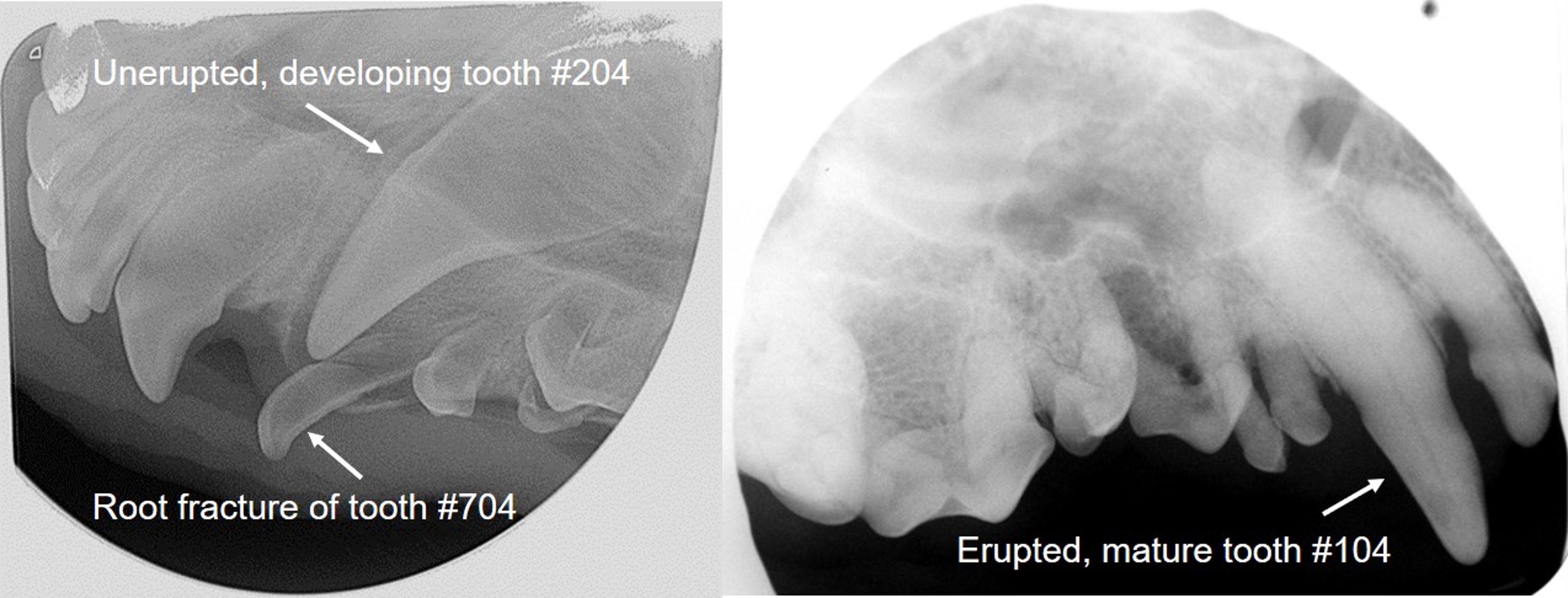
Intraoral radiographic views displaying physiological narrowing of the root canal of the maxillary canine tooth of a dog related to the dentinal deposition that occurs with age.
Courtesy of Dr. Maria Soltero-Rivera.
While there is a correlation between aging and narrowing of the pulp cavity, variation in root canal width can be pathological rather than part of the normal process of tooth maturation and present in teeth affected by endodontic disease. Additionally, differences in bisecting-angle technique can impact accuracy of pulp width measurements. Therefore, exact root canal widths are not a precise way to estimate age.
For More Information
References
Earley ET, Reiswig JD. Equine dental floating (crown osontoplasty). Vet Clin North Am Equine Pract. 2020;36(3):501-526. doi:10.1016/j.cveq.2020.08.011