Pityriasis rosea is a form of dermatitis in young pigs. Diagnosis is made based on the characteristic clinical signs and a self-limiting disease course: the lesions are ringlike collarettes with scale and may be diffusely distributed on the body. The etiology is unknown, and treatment is generally unnecessary.
Pityriasis rosea (pustular psoriaform dermatitis) is a sporadic disease of unknown etiology. It usually affects pigs 3–14 weeks old. However, it can occasionally occur in pigs as young as 2 weeks old and very rarely as old as 10 months. One or more pigs in a litter can be affected.
Clinical signs of pityriasis rosea are typically mild; however, transient anorexia and diarrhea can occur. The initial skin lesions are characterized by small erythematous papules that rapidly expand to form a ring (collarette) with distinct raised and reddened borders.
Pityriasis rosea lesions enlarge at their periphery, and adjacent lesions can coalesce. The center of the lesion is flat and covered with scale overlying normal skin. The lesions occur predominantly on the ventral abdomen and inner thighs; however, they occasionally can occur over the back, neck, and legs. Characteristically, there is no pruritus, and recovery is spontaneous in 4–8 weeks. Treatment is generally considered unnecessary.
Diagnosis of pityriasis rosea can usually be made from the clinical presentation and characteristic gross lesions (see , , and lesion images). However, laboratory tests, cultures, and tissue biopsies can be analyzed to differentiate it from dermatomycosis, exudative epidermitis, dermatosis vegetans, and swinepox.

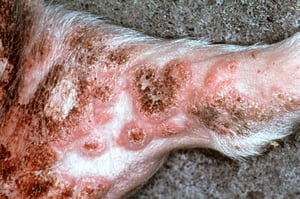
Hindlimb of a pig with pityriasis rosea. Note the multiple lesions, including small, ringlike, early-stage lesions and older, expanding, larger rings that heal from the center.
Hindlimb of a pig with pityriasis rosea. Note the multiple lesions, including small, ringlike, early-stage lesions and
Courtesy of Dr. Ranald D. A. Cameron.
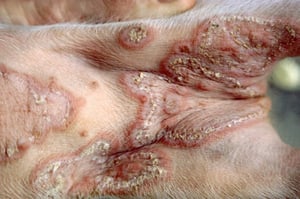
Pityriasis rosea lesions on the ventral abdomen and hindleg of a young pig. Note the raised, red appearance with dry flakes centrally, indicating healing from the center, as the ringlike lesions spread outward.
Pityriasis rosea lesions on the ventral abdomen and hindleg of a young pig. Note the raised, red appearance with dry fl
Courtesy of Dr. Ranald D. A. Cameron.

Abdomen and flank of a pig with pityriasis rosea. Note the typical ringlike lesions with raised red perimeters and healing central areas.
Abdomen and flank of a pig with pityriasis rosea. Note the typical ringlike lesions with raised red perimeters and heal
Courtesy of Dr. Ranald D. A. Cameron.
Hindlimb of a pig with pityriasis rosea. Note the multiple lesions, including small, ringlike, early-stage lesions and older, expanding, larger rings that heal from the center.
Hindlimb of a pig with pityriasis rosea. Note the multiple lesions, including small, ringlike, early-stage lesions and
Courtesy of Dr. Ranald D. A. Cameron.
Pityriasis rosea lesions on the ventral abdomen and hindleg of a young pig. Note the raised, red appearance with dry flakes centrally, indicating healing from the center, as the ringlike lesions spread outward.
Pityriasis rosea lesions on the ventral abdomen and hindleg of a young pig. Note the raised, red appearance with dry fl
Courtesy of Dr. Ranald D. A. Cameron.
Abdomen and flank of a pig with pityriasis rosea. Note the typical ringlike lesions with raised red perimeters and healing central areas.
Abdomen and flank of a pig with pityriasis rosea. Note the typical ringlike lesions with raised red perimeters and heal
Courtesy of Dr. Ranald D. A. Cameron.
Histopathological evaluation of pityriasis rosea lesions is often unhelpful. Findings can include a mixed superficial perivascular dermatitis (often with an eosinophilic component) as well as parakeratosis and epidermal hyperplasia, all of which are often present in other porcine cutaneous conditions to varying degrees.
Pearls & Pitfalls
|
Pityriasis rosea is considered to be partially hereditary, with pigs of the Landrace breed most commonly affected; however, the mode of inheritance is uncertain. The disease does not resemble pityriasis rosea in humans clinically or pathologically.
Pityriasis rosea lesions appear to be more extensive in pigs reared in high stocking densities with high ambient temperatures and high humidity. Under these conditions, secondary bacterial infection (eg, Staphylococcus hyicus) is common. Treatment is of little value and does not affect the course of the disease; however, treatment aimed at controlling secondary infections might be warranted.
For More Information
Sturos M. Integumentary system — skin, hoof, and claw. In: Zimmerman JJ, Burrough ER, Karriker LA, Schwartz KJ, Zhang J, eds. Diseases of Swine. 12th ed. John Wiley & Sons; 2025:329. doi:10.1002/9781394179466.ch17
Neumann EJ, Ramirez A, Schwartz KJ, eds. Pityriasis rosea. In: Swine Disease Manual. 5th ed. American Association of Swine Veterinarians; 2020:151. https://www.scribd.com/document/612439976/Swine-Disease-Manual-E-J-Neumann-A-Ramirez-and-K-J-Schwartz-5th-Edition-2020
Hargis AM, Myers S. The Integument. In: Zachary JF, ed. Pathologic Basis of Veterinary Disease. 7th ed. Elsevier; 2022:1232-1233. doi:10.1016/b978-0-323-35775-3.00017-5