Sarcocystosis is an intracellular protozoal infection that is highly prevalent and generally subclinical but can cause mild GI and neuromuscular signs in cattle, sheep, pigs, horses, dogs, cats, and humans. Typical control strategies are to prevent the ingestion of prey or raw tissues (mainly muscles) from infected intermediate hosts and to decrease contamination of grass and water with feces of definitive hosts.
Sarcocystosis is an intracellular infection, generally chronic and subclinical, that is caused by apicomplexan protozoa of the genus Sarcocystis (from the Greek sarx for "meat" and kystis for "bladder" or "pouch").
These protozoa have an indirect, mainly predator-prey life cycle. The primary finding is the presence of macroscopic and/or microscopic muscle cysts (sarcocysts) in the intermediate hosts (prey). Occasionally, eosinophilic myositis related to sarcocysts arises.
The presence of macroscopic sarcocysts and zoonotic species (eg, Sarcocystis hominis in beef and Sarcocystis suihominis in pork) could result in meat condemnation. No effective treatment has been reported for the intracellular chronic stage (sarcocysts).
Sarcocystis cysts are septate and contain thousands to millions of banana-shaped bradyzoites (see ).


Scanning electron micrograph showing a Sarcocystis aucheniae cyst. Note the septum and the banana-shaped bradyzoites. Scale bar = 10 mcm.
Courtesy of Dr. Gastón Moré.
Etiology, Transmission, and Pathogenesis of Sarcocystosis
Sarcocystis spp normally develop in two-host cycles consisting of an intermediate host (prey, for asexual reproduction and muscle cyst development) and a final host (predator or scavenger, for intestinal sexual reproduction and production of mature oocysts). (See life cycle diagram.)
More than 250 different Sarcocystis species have been described, and most are distributed worldwide. Species-specific prey-predator life cycles that have been demonstrated include the following (1, 2):
cattle-cat (S hirsuta)
cattle-dog (S cruzi)
cattle-human (S heydorni, S hominis, S sigmoideus)
goat-cat (S moulei)
goat-dog (S capracanis, S hircicanis)
horse-dog (S bertrami [syn S fayeri])
llama-dog (S aucheniae, S masoni)
pig-dog (S miescheriana)
pig-human (S suihominis)
pigeon-hawk (S calchasi)
sheep-cat (S gigantea, S medusiformis)
sheep-dog (S arieticanis, S tenella)
Some wildlife can be intermediate hosts (eg, birds, cervids, raccoons, rodents) or final hosts (eg, coyotes, opossums, snakes, wolves) for some species of Sarcocystis.
Approximately 1–2 weeks after ingesting muscle tissue that contains Sarcocystis spp cysts, the final host sheds infective oocysts and sporocysts in feces for several months. Intestinal infections in most final hosts are subclinical; occasionally, however, mild abdominal signs and symptoms like diarrhea and abdominal pain can occur in humans and dogs.
After ingestion of Sarcocystis sporocysts by a suitable intermediate host, sporozoites are liberated and initiate the development of schizonts in vascular endothelia of mesenteric arterioles and lymph nodes. A second generation of endothelial schizonts is produced in capillaries from several organs. Merozoites released from these schizonts invade the muscle fibers and develop into typical sarcocysts.
Initially, the cyst contains only a few metrocytes (merozoites that are rounded to slightly elongated), which give rise to the banana-shaped infective bradyzoites found in mature cysts (2–3 months after infection). Sarcocysts of some species are macroscopic (eg, S aucheniae, S hirsuta, S gigantea, S medusiformis, etc); however, most species are microscopic, even when large numbers of cysts are present within the muscle tissue.
Equine protozoal myeloencephalitis (EPM) is caused principally by Sarcocystis neurona in horses from North and South America. Only asexual stages of S neurona have been found in horses, and they might be located in neurons and leukocytes of the brain and spinal cord (aberrant host). Opossums (Didelphis virginiana and Didelphis albiventris) are its definitive hosts.
S cruzi produces microscopic cysts, principally in myocardium, and can affect up to 100% of some cattle populations.
S hirsuta has been primarily responsible for beef condemnation because of visible sarcocysts.
S miescheriana is the most important species affecting pigs and might affect meat quality.
Macroscopic cysts of S aucheniae are an important cause of condemnation of llama, alpaca, and guanaco meat (see ).

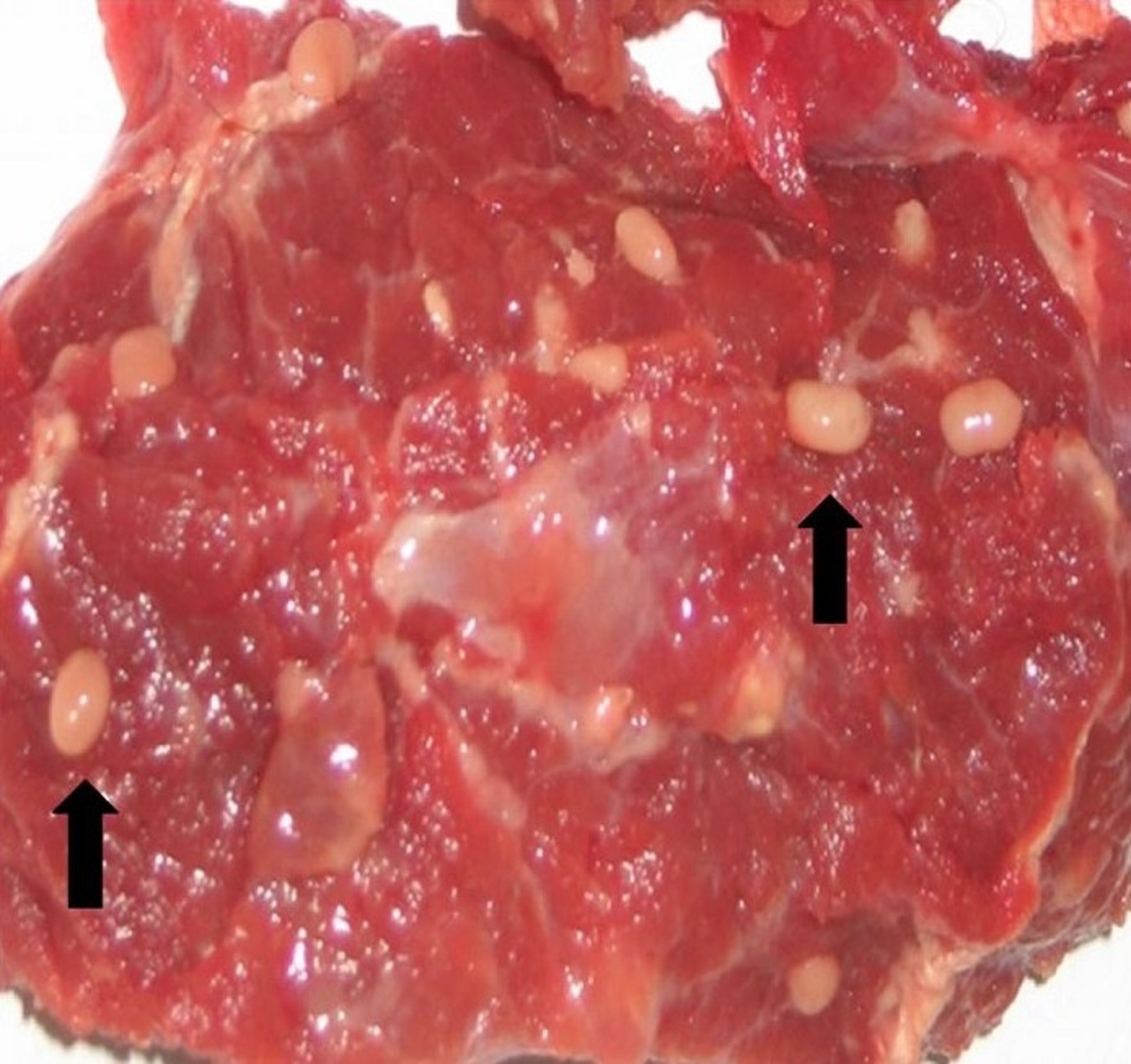
Llama meat containing several macroscopic Sarcocystis aucheniae cysts (arrows).
Courtesy of Dr. Gaston Moré.
Natural Sarcocystis infections are usually subclinical. However, experimental infections with S cruzi sporocysts have caused acute disease in calves; eosinophilic myositis in cattle; and abortions, stillbirths, and deaths in pregnant cows. Cases of necrotic encephalitis and fatal myocarditis in heifers have been reported (1).
Similar pathogenicity has been demonstrated for S tenella in lambs and ewes and for S miescheriana in pigs. An outbreak of myositis affecting 20 ewes with flaccid paralysis was the result of heavy Sarcocystis infection (1).
Immune status of the host and the dose of Sarcocystis sporocysts might be the most important factors for development of clinical signs. Natural infections are assumed to occur frequently with low numbers of sporocysts, leading to chronic and subclinical infections. Pathological changes in myocardium and skeletal muscles have been found to be more pronounced in cows with lymphatic leukemia (1, 3).
Pearls & Pitfalls
|
A prophylactic vaccination procedure using small doses of sporocysts has been found to prevent the development of sarcocystosis clinical signs or decrease their severity in sheep when challenged with large doses later (premunitive immunity) (4). In dogs, which serve as definitive hosts, repeated infection is associated with a prolonged prepatent period and a shortened patent period.
Humans can also serve as intermediate aberrant Sarcocystis hosts and suffer myositis and vasculitis. These symptoms have been reported from tourists in Malaysia who apparently ingested Sarcocystis nesbitti sporocysts (monkey-snake life cycle) from food or water contaminated with snake feces (5).
Human intestinal illness, with clinical signs and symptoms of abdominal pain, loss of appetite, nausea, vomiting, and diarrhea lasting up to 48 hours, has followed ingestion of raw or undercooked pork or beef containing sarcocysts of S suihominis and S hominis, respectively (6).
Morphological and molecular differentiation of S hominis and S suihominis cysts from cysts of nonzoonotic species is extremely important. Accurate identification of sarcocyst species not only protects public health, but also ensures that meat is not unnecessarily condemned because of the presence of harmless species. Species can be identified by molecular studies and cyst wall morphology (mainly ultrastructure, by transmission electron microscopy).
In addition to the zoonotic concern, Sarcocystis spp infections in cattle are of interest because of their potential association with bovine eosinophilic myositis, an inflammatory myopathy characterized by multifocal gray to greenish lesions implicating meat rejections (2).
Potential food poisoning in humans has been reported after ingestion of South American camelid meat containing S aucheniae cysts, as well as venison, whale, and horse meat containing Sarcocystis spp cysts (1).
Clinical Findings of Sarcocystosis
Sarcocystis spp infections are quite prevalent in farm animals (> 70% in some herbivore populations); however, there have been few outbreaks of disease. Most infected animals are subclinically affected, and the tissue cysts (chronic stage) are discovered only at slaughter.
Clinical signs in cattle acutely affected with S cruzi include fever, anorexia, cachexia, decreased milk yield, diarrhea, muscle spasms, anemia, loss of tail hair, hyperexcitability, weakness, prostration, and death. Infection during the last trimester of pregnancy might lead to abortion in cows. After recovery from acute illness, calves fail to grow well and eventually die in a cachectic state (7).
Anemia, hepatitis, and myocarditis were the primary lesions of acute infection in sheep after experimental challenge with S tenella sporocysts (1). After recovery from acute illness, some sheep lose their wool. S tenella might also induce abortion in sheep. At necropsy, acutely affected animals show hemorrhage of the serous membranes of the viscera and myocardium.
Sarcocystis spp infections are probably most important in growing ruminants and swine, in which they can cause subclinical anemia and decreased weight gain.
Sarcocystosis in dogs and cats is usually subclinical; however, acute to chronic diarrhea might occur. Sarcocystis caninum and Sarcocystis svanai infections have been associated with severe myositis and hepatitis in dogs (8).
Clinical signs of equine protozoal myeloencephalitis include gait abnormalities such as ataxia, knuckling, and crossing over. Muscle atrophy of the hindlimb, which is usually unilateral, is common. EPM lesions are typically multifocal, and brainstem involvement is common. Depression, weakness, head tilt, and dysphagia are other possible signs.
EPM can mimic many neurological diseases. Horses can also develop myopathy. Multifocal myositis has been reported and might be caused by another Sarcocystis species—S bertrami (syn S fayeri)—with horses as the intermediate host.
S calchasi can produce protozoal encephalitis in pigeons with severe brain lesions and muscle cysts at the same time.
Diagnosis of Sarcocystosis
Intermediate hosts:
Histopathological findings
Serological testing
Transmission electron microscopy
Artificial digestion
Molecular diagnostics
Definitive hosts:
Fecal flotation
Intestinal scraping at necropsy
Molecular diagnostics
Because clinical signs of sarcocystosis are often nonspecific, diagnosis of Sarcocystis infection relies on a combination of histological, serological, and molecular diagnostic modalities.
Histological evaluation of biopsy or necropsy tissues is commonly used for diagnosis of sarcocystosis. Merozoites and sarcocysts might be detected in muscle, eyes, tongue, brain, heart, lungs, liver, and intestines. Associated lesions frequently include granulomatous inflammation and tissue necrosis. Immunohistochemistry (IHC) can be used to confirm infection and assist in differentiating among species.
Direct agglutination assays can detect antibodies against Sarcocystis but cannot distinguish between acute infections and recrudescent or past exposure. Indirect fluorescent antibody tests (IFATs), ELISA, and Western blot performed on serum or plasma can help differentiate certain Sarcocystis spp (9). However, most of these tests detect antibodies directed to shared antigens, and species differentiation is not possible. Therefore, most serological methods detect antibodies to only the genus level.
Pearls & Pitfalls
|
PCR assay and DNA sequencing enable more reliable differentiation among closely related Sarcocystis spp.
Both PCR assay and specific serological testing are important diagnostic methods for equine protozoal myeloencephalitis.
Transmission electron microscopy (TEM) can provide ultrastructural visualization of sarcocysts and parasite developmental stages, enabling detailed characterization of cyst wall morphology and other structural features that can aid in species differentiation.
Sarcocystis spp oocysts and sporocysts are occasionally detected in fecal samples (see ).


Photomicrograph showing Sarcocystis sp oocysts. Each oocyst contains two oval sporocysts with four sporozoites each. Note the thin oocyst wall. Scale bar = 10 mcm.
Courtesy of Dr. Gastón Moré.
Control of Sarcocystosis
No effective treatment for chronic intracellular sarcocysts
Prevent ingestion of prey carcasses or raw tissues
Decrease grass and water contamination with infected feces
Antiprotozoal medication
Because most adult cattle, sheep, and many pigs harbor sarcocysts in their muscles, dogs and other carnivores should not be allowed to eat raw meat, offal, or dead animals. Supplies of grain and feed should be kept covered. Dogs and cats should not be allowed in buildings used to store feed or to house animals.
Amprolium (100 mg/kg, every 24 hours for 30 days), fed prophylactically, has been found to decrease illness in cattle inoculated with S cruzi (10). However, in the US, extralabel drug use in food animals is not allowed when the drug is administered in feed, with an exception for specific circumstances in minor species outlined in the FDA Compliance Policy Guide (CPG).
Prophylactic administration of amprolium or salinomycin has been shown to be effective in preventing severe illness and death in sheep experimentally infected with Sarcocystis (1, 11).
Vaccines are not available.
Experimental work demonstrated that pork and beef infected with Sarcocystis could be made safe for consumption by cooking at 70°C (158°F) for 15 minutes or by freezing at –4°C (24.8°F) for 5 days or at –20°C (–4°F) for 2 days (1).
The combination of pyrimethamine and sulfadiazine is available as an FDA-approved oral suspension (1 mg/kg and 20 mg/kg, respectively, PO, every 24 hours for a prolonged period [usually 40 days or longer]) for treatment of horses with equine protozoal myeloencephalitis (12).
Pyrimethamine has been associated with rare serious adverse effects, including myelosuppression and seizures, particularly when administered at high doses. Progressive mild anemia is common with pyrimethamine treatment. Pyrimethamine is teratogenic and has also been noted to cause a fatal syndrome in foals when mares are treated in late pregnancy (13, 14).
Ponazuril (also FDA approved), is widely used to treat EPM. The dosage commonly used is 15 mg/g, PO, on day 1, followed by 5 mg/kg, PO, every 24 hours for at least 27 days (13, 15).
Diclazuril (1 mg/kg as alfalfa-based pellets, every 7 days) might be useful as a prophylactic agent against S neurona (16).
Key Points
Sarcocystosis is a chronic and subclinical protozoal infection distributed worldwide that affects muscles of animals and humans. Eosinophilic myositis and hepatitis might be related to Sarcocystis spp infections.
The presence of macroscopic sarcocysts (S aucheniae, S hirsuta, S gigantea, and others) and zoonotic species (S hominis, S sigmoideus, S heydorni, and S suihominis) can result in meat condemnation.
Intestinal infections in final hosts are generally subclinical; however, humans and dogs can experience abdominal symptoms and signs.
In addition to the zoonotic concern, there is increasing interest about Sarcocystis spp infections in meat-producing animals and the potential association of these infections with eosinophilic myositis and food poisoning events.
For More Information
Sarcocystosis. CDC.
Also see pet owner content regarding sarcocystosis in dogs and cats.
References
Dubey JP, Calero-Bernal R, Rosenthal BM, Speer CA, Fayer R. Sarcocystosis of Animals and Humans. 2nd ed. CRC Press;2016.
Rubiola S, Moré G, Civera T, et al. Detection of Sarcocystis hominis, Sarcocystis bovifelis, Sarcocystis cruzi, Sarcocystis hirsuta and Sarcocystis sigmoideus sp. nov. in carcasses affected by bovine eosinophilic myositis. Food Waterborne Parasitol. 2024;34:e00220. doi:10.1016/j.fawpar.2024.e00220
Kumar V, Singh V, Kumar P, Kumar VSD, Babu S. Sarcocysts as a common post mortem finding in heart muscles of cattle: necropsy case report. Int J Vet Sci Anim Husb. 2023;8(SP-2):53-57. doi:10.22271/veterinary.2023.v8.i2Sa.562
O'Donoghue PJ, Wilkinson RG. Antibody development and cellular immune responses in sheep immunized and challenged with Sarcocystis tenella sporocysts. Vet Parasitol. 1988;27(3-4):251-265. doi:10.1016/0304-4017(88)90040-4
Tappe D, Slesak G, Pérez-Girón JV, et al. Human invasive muscular sarcocystosis induces Th2 cytokine polarization and biphasic cytokine changes, based on an investigation among travelers returning from Tioman Island, Malaysia. Clin Vaccine Immunol. 2015;22(6):674-677. doi:10.1128/CVI.00042-15
Rosenthal BM. Zoonotic Sarcocystis. Res Vet Sci. 2021;136:151-157. doi:10.1016/j.rvsc.2021.02.008
Carrigan MJ. An outbreak of sarcocystosis in dairy cattle. Aust Vet J. 1986;63(1):22-24. doi:10.1111/j.1751-0813.1986.tb02866.x
Dubey JP, Sykes JE, Shelton GD, et al. Sarcocystis caninum and Sarcocystis svanai n. spp. (Apicomplexa: Sarcocystidae) associated with severe myositis and hepatitis in the domestic dog (Canis familiaris). J Eukaryot Microbiol. 2015;62(3):307-317. doi:10.1111/jeu.12182
Duarte PC, Daft BM, Conrad PA, et al. Evaluation and comparison of an indirect fluorescent antibody test for detection of antibodies to Sarcocystis neurona, using serum and cerebrospinal fluid of naturally and experimentally infected, and vaccinated horses. J Parasitol. 2004;90(2):379-386. doi:10.1645/GE-3263
Fayer R, Dubey JP. Protective immunity against clinical sarcocystosis in cattle. Vet Parasitol. 1984;15(3-4):187-201. doi:10.1016/0304-4017(84)90071-2
Leek RG, Fayer R. Amprolium for prophylaxis of ovine Sarcocystis. J Parasitol. 1980;66(1):100-106. doi:10.2307/3280598
MacKay RJ, Howe DK. Equine protozoal myeloencephalitis. Vet Clin North Am Equine Pract. 2022;38(2):249-268. doi:10.1016/j.cveq.2022.05.003
Reed SM, Furr M, Howe DK, et al. Equine protozoal myeloencephalitis: an updated consensus statement with a focus on parasite biology, diagnosis, treatment, and prevention. J Vet Intern Med. 2016;30(2):491-502. doi:10.1111/jvim.13834
Toribio RE, Bain FT, Mrad DR, et al. Congenital defects in newborn foals of mares treated for equine protozoal myeloencephalitis during pregnancy. J Am Vet Med Assoc. 1998;212(5):697-701. doi:10.2460/javma.1998.212.05.697
Furr M, Kennedy T, MacKay R, et al. Efficacy of ponazuril 15% oral paste as a treatment for equine protozoal myeloencephalitis. Vet Ther. 2001;2(3):215-222.
Pusterla N, Vaala W, Bain FT, et al. Pharmacokinetics of a FDA-labeled dose of diclazuril administered orally once weekly to adult horses. J Equine Vet Sci. 2023;120:104183. doi:10.1016/j.jevs.2022.104183