Dental disease is common in rabbits because all of their teeth grow continuously. Eating plenty of hay helps wear the teeth down and lowers the risk of developing dental problems.
Dental Malocclusion in Rabbits
All rabbit teeth, including the front teeth (the incisors) and the back teeth (the premolars and molars), keep growing throughout life. Normally, chewing wears them down. When the upper and lower teeth don't line up properly, a condition called malocclusion develops. With malocclusion, the top and bottom teeth don't meet exactly when the rabbit closes its mouth or chews, resulting in uneven wear of the top and bottom teeth. This is one of the most common inherited problems in rabbits and can cause both front and back teeth to grow too long.
Rabbits with malocclusion can have very long incisors, unevenly worn teeth, drooling, or trouble closing the mouth, eating, and drinking. A veterinarian can trim the teeth under anesthesia to ease discomfort and make it easier for a rabbit to eat.
Teeth malocclusion, rabbit

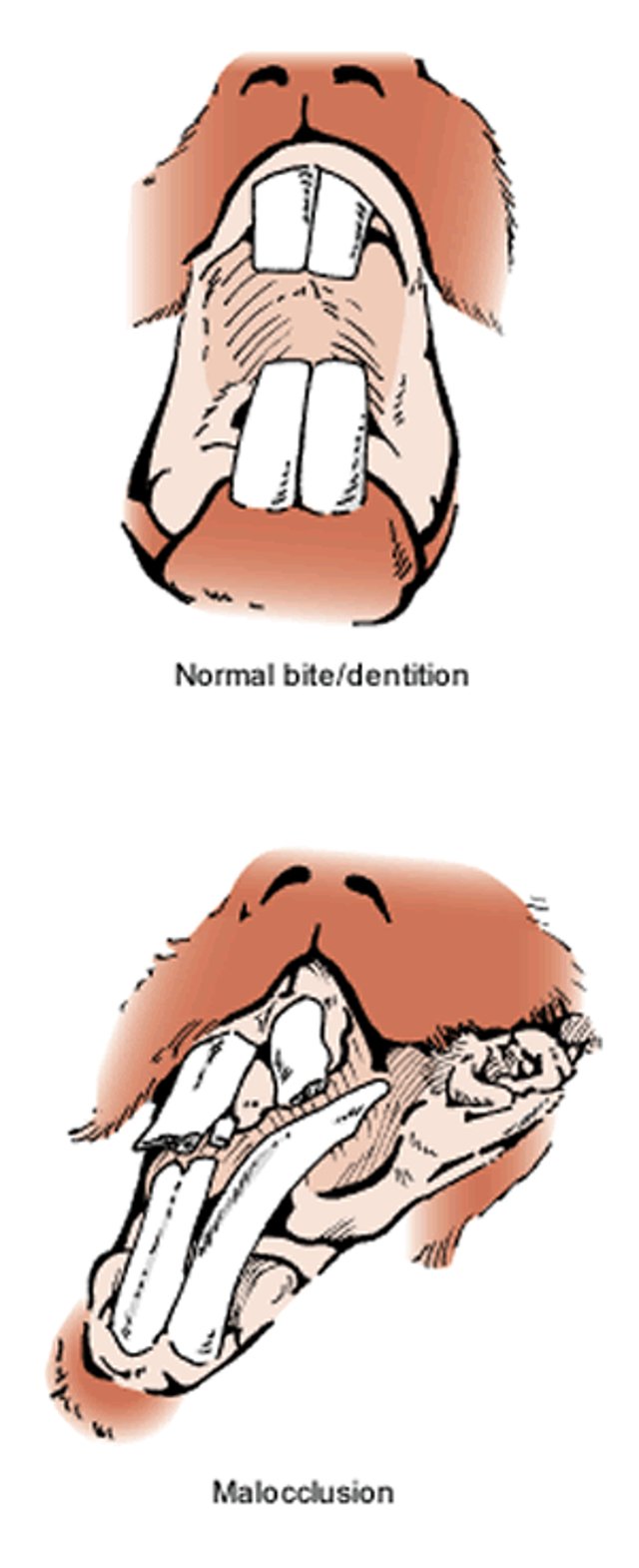
Malocclusion can appear in rabbits as young as 3–8 weeks old. Young rabbits can also damage their teeth by biting cage wire. In addition, rabbits that eat mainly pellets instead of hay can develop overgrown teeth because chewing on pellets doesn't wear the teeth down effectively like chewing on hay does.
Overgrown cheek teeth can form sharp edges or points that cut the tongue or cheeks. Small cuts inside the mouth or on the gums can become infected. Your vet can file down these edges and points after sedating the rabbit.
Dental Abscesses in Rabbits
Infection around a tooth can produce an abscess, which is a pocket of pus around the tooth root. These infections begin when food gets trapped between the tooth and gum, when sharp points or edges of teeth injure the mouth, when the center of a tooth (called the pulp) is exposed after trimming teeth too short, or when other dental or dietary problems are present.
Abscesses often affect several teeth. Diagnosis usually requires sedating the rabbit for a full dental exam and doing x-rays or a CT scan. The infected tooth might need to be removed. If many teeth are affected, full recovery is less likely, and abscesses often come back even after treatment. In some cases, long-term antibiotics prescribed by your vet are the main option to manage, but not eliminate, the abscess.
For More Information
See also professional content regarding dental disease of rabbits.