Toxoplasmosis is an important zoonotic protozoal infection worldwide. All homeothermic animal species can be infected. Infection is generally subclinical and chronic in immunocompetent individuals. Common clinical signs are abortion and reproductive failure (especially in small ruminants, cervids, and pigs) and pneumonitis and ocular and neurological alterations in companion animals. Some susceptible animal species (eg, Australian marsupials, New World monkeys, and meerkats), as well as immunocompromised individuals, suffer multiorgan failure, resulting in death. Humans can experience retinochoroiditis (ocular toxoplasmosis) or fetal neurological disorders (congenital toxoplasmosis). Monitoring by means of serological testing is recommended to guide the application of anticoccidial treatments.
Etiology and Pathogenesis of Toxoplasmosis
Toxoplasma gondii is an apicomplexan protozoon that infects humans and other warm-blooded animals worldwide, including birds and marine mammals. This intracellular parasite has a facultative, indirect life cycle, reproducing sexually in enterocytes from definitive hosts and asexually in nucleated cells from intermediate hosts.
Felids are the only definitive hosts of T gondii, which contaminates the environment with oocysts eliminated in feces (see T gondii ).

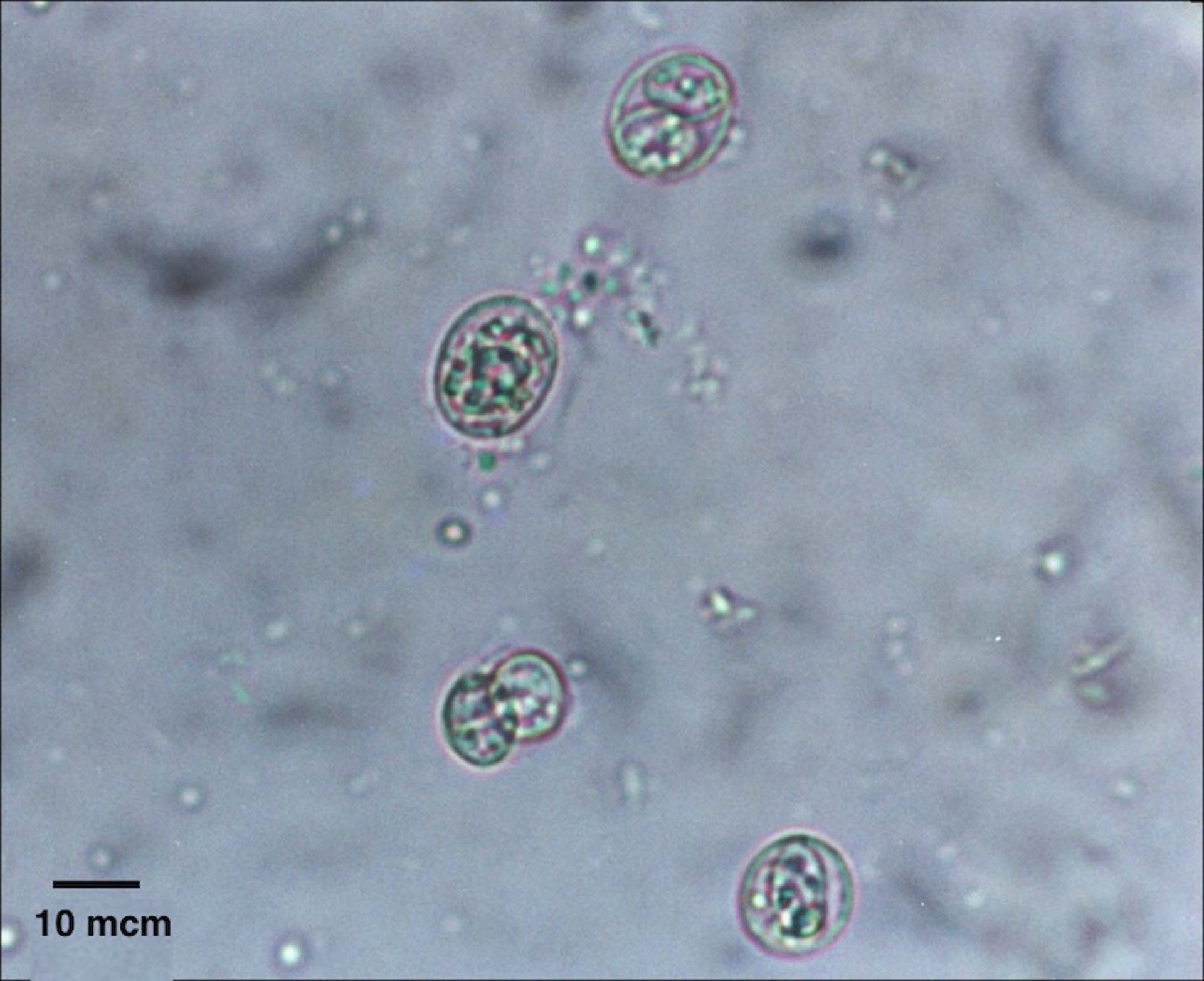
Photomicrograph of Toxoplasma gondii oocysts in a cat stool sample. Note three sporulated oocysts (two sporocysts each) and one immature/unsporulated oocyst. Scale bar = 10 mcm. Original magnification 40X.
Courtesy of Dr. Gastón Moré.
T gondii has three infectious stages:
tachyzoites (rapidly multiplying form)
bradyzoites (slow division form contained in tissue cysts)
sporozoites (in mature or sporulated oocysts)
Different T gondii genotypes exhibit different behaviors and virulence. Genotypes detected in South America, Africa, and Asia are considered more virulent than those predominating in Europe and North America (1).
T gondii is transmitted by consumption of infectious oocysts from a contaminated environment, consumption of tissue cysts in infected meat, and transplacental transfer of tachyzoites from mother to fetus. T gondii initiates enteroepithelial replication in unexposed felids after ingestion of uncooked tissues containing cysts. Bradyzoites are released from tissue cysts by digestion in the stomach and small intestine, invading intestinal epithelium, and undergoing asexual and sexual replication, culminating in the release of oocysts (approximately 10 mcm in diameter) in the feces.
Oocysts are first evident in the feces 3 days after infection and can be released for up to 20 days. Oocysts sporulate (become infectious) outside the cat within 1–5 days, depending on aeration and temperature, and remain viable in the environment for several months. Cats generally develop immunity to T gondii after the initial infection and shed oocysts only once in their lifetime; however, immunocompromised animals can re-shed oocysts. Felids are also intermediate hosts for extraintestinal asexual multiplication of the parasite, especially in nervous system cells. Neurological and ocular lesions can arise in immunocompromised and elderly cats.
After being consumed in undercooked meat containing tissue cysts (carnivores) or in feed or drink contaminated with cat feces containing oocysts (all warm-blooded animals), T gondii initiates extraintestinal replication. Bradyzoites and sporozoites, respectively, are released and infect intestinal epithelium and other tissues. After asexual replication, tachyzoites emerge and disseminate via the bloodstream and lymph. Tachyzoites infect tissues throughout the body and replicate intracellularly until the cells burst, causing tissue necrosis. Tachyzoites are banana shaped and measure 4–6 × 2–3 mcm.
Susceptible species and young, immunocompromised animals (eg, puppies, kittens, piglets) can die from generalized toxoplasmosis at this stage of illness. Adult animals mount a powerful, cell-mediated immune response (mediated by cytokines) and control infection, driving the tachyzoites into the tissue cyst or bradyzoite stage.
Tissue cysts occur mainly in neurons and skeletal muscles. Individual cysts are microscopic, up to 100 mcm in diameter, and can enclose hundreds of bradyzoites in a thin, resilient cyst wall (see T gondii ). Tissue cysts in the host remain viable for many years, and possibly for the life of the host, thus serving as an important source of infection for scavengers, carnivores, and omnivores (1). See also the .


Photomicrograph of a Toxoplasma gondii tissue cyst from a mouse brain homogenate. Unstained; scale bar = 20 mcm. Original magnification 40X.
Courtesy of Dr. Gastón Moré.

Clinical Findings of Toxoplasmosis
The tachyzoite stage is responsible for tissue damage in toxoplasmosis; therefore, clinical signs depend on the affected tissue, the number of tachyzoites released, and the ability of the host immune system to limit replication and transmission. Because adult immunocompetent animals control tachyzoite multiplication and transmission efficiently, toxoplasmosis is usually a subclinical illness. However, in susceptible species, as well as in young and immunocompromised animals (particularly puppies, kittens, and piglets), tachyzoites replicate systemically and cause interstitial pneumonia, myocarditis, hepatic necrosis, meningoencephalomyelitis, chorioretinitis, lymphadenopathy, and myositis. Corresponding clinical signs include fever, diarrhea, cough, dyspnea, icterus, seizures, and sudden death.
Pearls & Pitfalls
|
T gondii is also an important cause of abortion and stillbirth in sheep, goats, cervids, and sometimes pigs. After infection of a pregnant ewe, tachyzoites are transmitted via the bloodstream to placental cotyledons, causing necrosis. Tachyzoites can also be transmitted to the fetus, causing necrosis in multiple organs. Finally, immunocompromised adult animals (eg, cats infected with feline immunodeficiency virus, organ transplant recipients, animals under immunosuppressive treatments, etc) are extremely susceptible to developing acute generalized toxoplasmosis, mainly expressed as neurological and respiratory disorders.
Women who acquire T gondii during pregnancy can develop a fever, and transplacental passage of tachyzoites to the fetus can occur. Veterinarians have a key role in preventing this zoonotic disease by helping to develop, disseminate, and apply control measures, as well as by identifying oocysts in fecal samples, environment, and water and by observing the presence of cysts in animal tissues (food safety).
Diagnosis of Toxoplasmosis
Indirect diagnosis by serological testing
Direct diagnosis via histological, bioassay, and molecular methods
Toxoplasmosis is diagnosed by biological, serological, or histological methods or some combination of these. Clinical signs of toxoplasmosis are nonspecific and are not sufficiently characteristic for a definitive diagnosis. Antemortem diagnosis can be accomplished by indirect hemagglutination assay, indirect fluorescent antibody test (IFAT), latex agglutination test, or ELISA (see to T gondii antigen).


Positive indirect fluorescent antibody test reaction using Toxoplasma gondii RH strain as antigen. Original magnification 40X.
Courtesy of Dr. Gastón Moré.
IgM antibodies appear sooner after infection than IgG antibodies; generally, however, IgM antibodies do not persist past 3 months after infection. Increased IgM titers (> 1:256) are consistent with recent infection (1). In contrast, IgG antibodies appear by the fourth week after infection and can remain increased for years during subclinical infection.
To be useful, IgG titers must be measured in paired serum samples obtained during the acute and convalescent stages (3–4 weeks apart) and must show at least a 4-fold increase or decrease in titer (positive or negative seroconversion, respectively). In addition, CSF and aqueous humor samples can be analyzed for the presence of tachyzoites or anti–T gondii antibodies. Additionally, biopsy and bronchoalveolar lavage can be used for direct diagnosis (histology, cytology and PCR assay).
Postmortem, tachyzoites may be evident in tissue impression smears. Histological examination of tissue sections can reveal the presence of tachyzoites or bradyzoites, which can be specifically marked by immunohistochemical staining (see T gondii, ).


Photomicrograph of a tissue cyst of Toxoplasma gondii in brain. Positive specific immunohistochemistry stain. Original magnification 40X.
Courtesy of Dr. Gastón Moré.
T gondii is morphologically similar to other protozoal parasites and must be differentiated from Sarcocystis sp and Neospora caninum, which can also be involved in abortions and infection of neurological tissues. Application of specific PCR assays allows diagnosis from tissue DNA samples. Once the presence of parasitic DNA is confirmed, the sample can be further processed for parasite genotyping.
Treatment of Toxoplasmosis
For acute toxoplasmosis: anti-coccidial drugs, administered as soon as possible after infection is suspected
For primary infection: specific treatment to avoid or minimize vertical transmission
Treatment of subclinical toxoplasmosis is not recommended. It is only performed after diagnosis of a primary infection during gestation in humans to prevent vertical transmission and fetal lesions.
Treatment is regularly administered for companion animals showing clinical signs. Cats with clinical signs of toxoplasmosis are generally treated with clindamycin hydrochloride (10–12.5 mg/kg, PO, every 12 hours) for 4 weeks or a trimethoprim-sulfonamide combination (15 mg/kg, PO, every 12 hours) for 4 weeks (2, 3). The trimethoprim-sulfonamide treatment combination is also recommended to treat dogs, as is clindamycin (10–20 mg/kg, PO or IM, every 12 hours) for a minimum of 4 weeks (4). Although these drugs are beneficial if given in the acute stage of the disease when there is active multiplication of the parasite, they will not usually eradicate infection.
Clindamycin, toltrazuril, ponazuril, and diclazuril may be administered to treat acute toxoplasmosis, as well as to decrease the shedding of oocysts by cats (4). No drugs are particularly effective at the bradyzoite stage.
Prevention and Zoonotic Risk of Toxoplasmosis
Toxoplasmosis is an important zoonotic disease. In some areas of the world, as much as 60% of the human population has serum IgG titers for T gondii and is likely to be persistently infected.
Toxoplasmosis is a major concern for people with compromised immune systems. In these individuals, toxoplasmosis usually presents as meningoencephalitis and results from the emergence of T gondii from tissue cysts located in the brain as immunity wanes (reactivation) rather than from primary infection.
Toxoplasmosis is also a concern for pregnant women because tachyzoites can migrate transplacentally and cause neurological disorders in the fetus. Infection with T gondii can occur after ingestion of undercooked meat or accidental ingestion of oocysts from cat feces thorough contaminated water or vegetables.
To prevent infection, hands should be washed thoroughly with soap and water after contact with meat or potentially contaminated environments. The stages of T gondii are killed by cooking and contact with boiling water, and boiling water should be used to clean all cutting boards, sink tops, knives, and other materials. T gondii can also be killed by freezing.
Tissue cysts are killed by heating throughout to 67°C (152.6°F) or by cooling to −13°C (8.6°F) (1). Toxoplasma bradyzoites in tissue cysts are also killed by exposure to 500 Gy (50 kilorad) of gamma irradiation (5). Meat of any animal should be cooked to 67°C (152.6°F) before consumption, and tasting meat while cooking or while seasoning should be avoided.
Pregnant women should avoid contact with cat litter, soil, and raw meat. Pet cats should be fed only dry, canned, or cooked food. The cat litter box should be emptied daily, preferably not by a pregnant woman. Gloves should be worn while gardening. Vegetables should be washed thoroughly before eating, because they might have been contaminated with cat feces.
No vaccine exists to prevent toxoplasmosis in humans. Some countries have approved a vaccine to prevent abortions in sheep.
Key Points
Toxoplasmosis is a zoonosis that affects all warm-blooded animals worldwide.
A high proportion of animals and humans are infected without clinical signs. Different T gondii genotypes could generate different clinical outcomes.
Immunocompromised individuals can develop generalized toxoplasmosis with multiorgan failure.
T gondii can be transmitted vertically and produce fetal lesions and abortions.
For More Information
ToxoDB: Toxoplasma Informatics Resources
Toxoplasmosis. Manual of Diagnostic Tests and Vaccines for Terrestrial Animals (Terrestrial Manual) of the World Organisation for Animal Health. 2018.
Moré G, Venturini MC, Pardini LL, Unzaga JM. Toxoplasma. In: Florin-Christensen M, Schnittger L, eds. Parasitic Protozoa of Farm Animals and Pets. Springer; 2018:149-168.
Also see pet owner content regarding toxoplasmosis in dogs and toxoplasmosis in cats.
References
Dubey JP. Toxoplasmosis of Animals and Humans. 3rd ed. CRC Press; 2022. doi:10.1201/9781003199373
Lappin MR. Update on the diagnosis and management of Toxoplasma gondii infection in cats. Top Companion Anim Med. 2010;25(3):136-141. doi:10.1053/j.tcam.2010.07.002
Addie D. Guideline for Toxoplasma gondii infection. European Advisory Board on Cat Diseases. https://www.abcdcatsvets.org/guideline-for-toxoplasma-gondii-infection/
Dubey JP, Lindsay DS, Lappin MR. Toxoplasmosis and other intestinal coccidial infections in cats and dogs. Vet Clin North Am Small Anim Pract. 2009;39(6):1009-1034. doi:10.1016/j.cvsm.2009.08.001
Dubey JP, Brake RJ, Murrell KD, Fayer R. Effect of irradiation on the viability of Toxoplasma gondii cysts in tissues of mice and pigs. Am J Vet Res. 1986;47(3):518-522. doi:10.2460/ajvr.1986.47.03.518