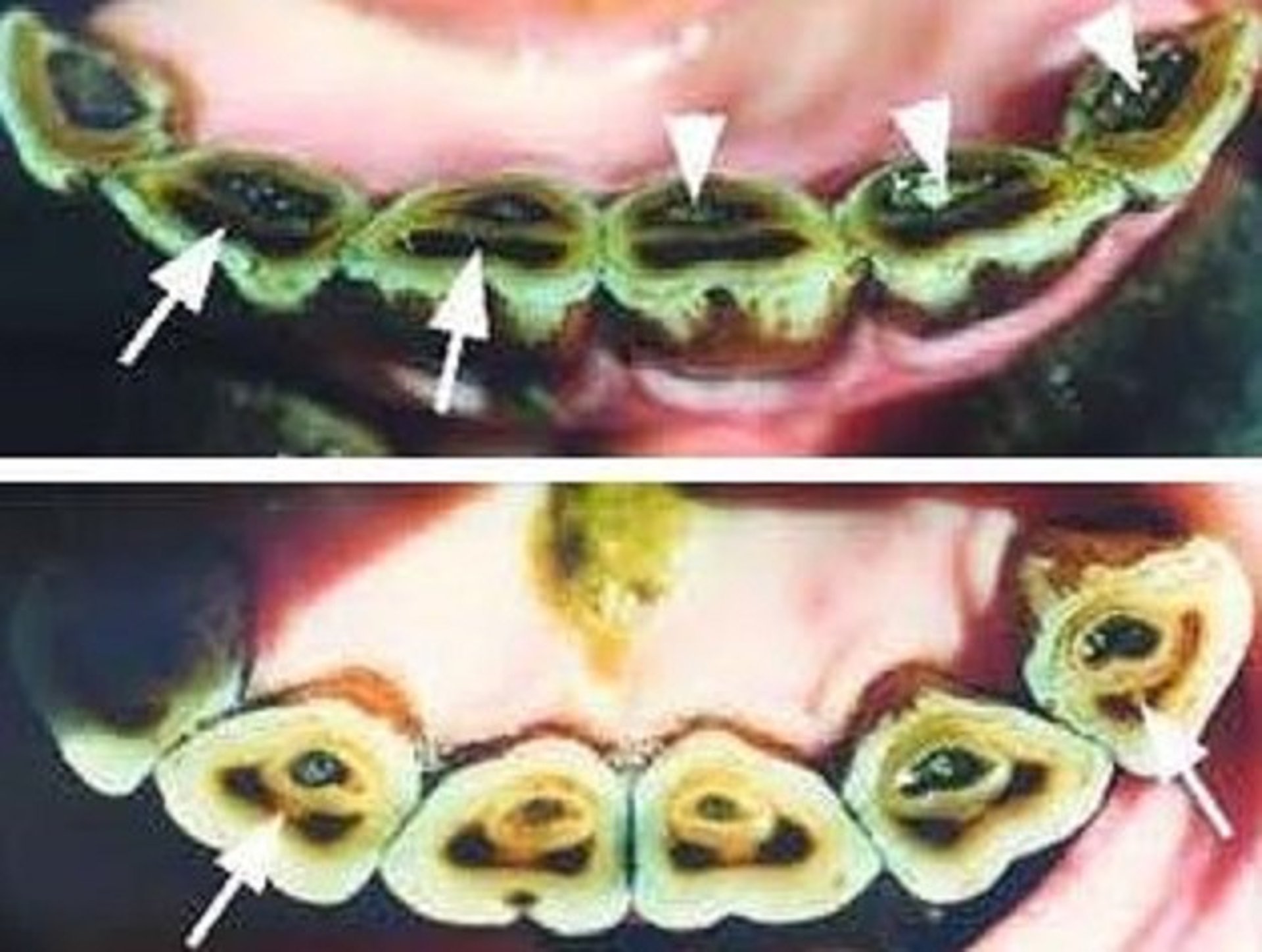
Lower incisors, mare
Top: Occlusal view of the lower incisors of a 6-year-old mare. Dental stars (pulp horns) are visible on I1 and I2 (arrows); dental cups (infundibulae) are present as large elliptical infoldings (arrowheads). They are dark stained/filled with feed because of incomplete formation of cementum during development. Occlusal surfaces of the incisors are typically described as oval at this younger age, and curvature of the dental arch is described as semicircular.
Bottom: Occlusal view of the lower incisors of a 12-year-old mare. In the center of the dental stars, a white spot is clearly visible (arrows), which is typical when there are two pulp horns. The dental cups have become smaller and shallower. The infundibulum does not occupy the entire length of the incisor crown. Eventually, with continued eruption and wear, the area where a dental cup used to be will be described as an "enamel spot," the colloquial term for the end of the infundibulum. The occlusal surfaces are typically described as more triangular as the horse ages and the crown wears over time.
Courtesy of Dr. Sofie Muylle.