Cytodites nudus is a small mite with worldwide distribution. It is challenging to diagnose but is occasionally noticed as white spots on the bronchi, lungs, air sacs, and abdominal organs of chickens, turkeys, pheasants, pigeons, canaries, and mallards (see ). These mites are difficult to identify but can sometimes be visualized by transillumination of the trachea.

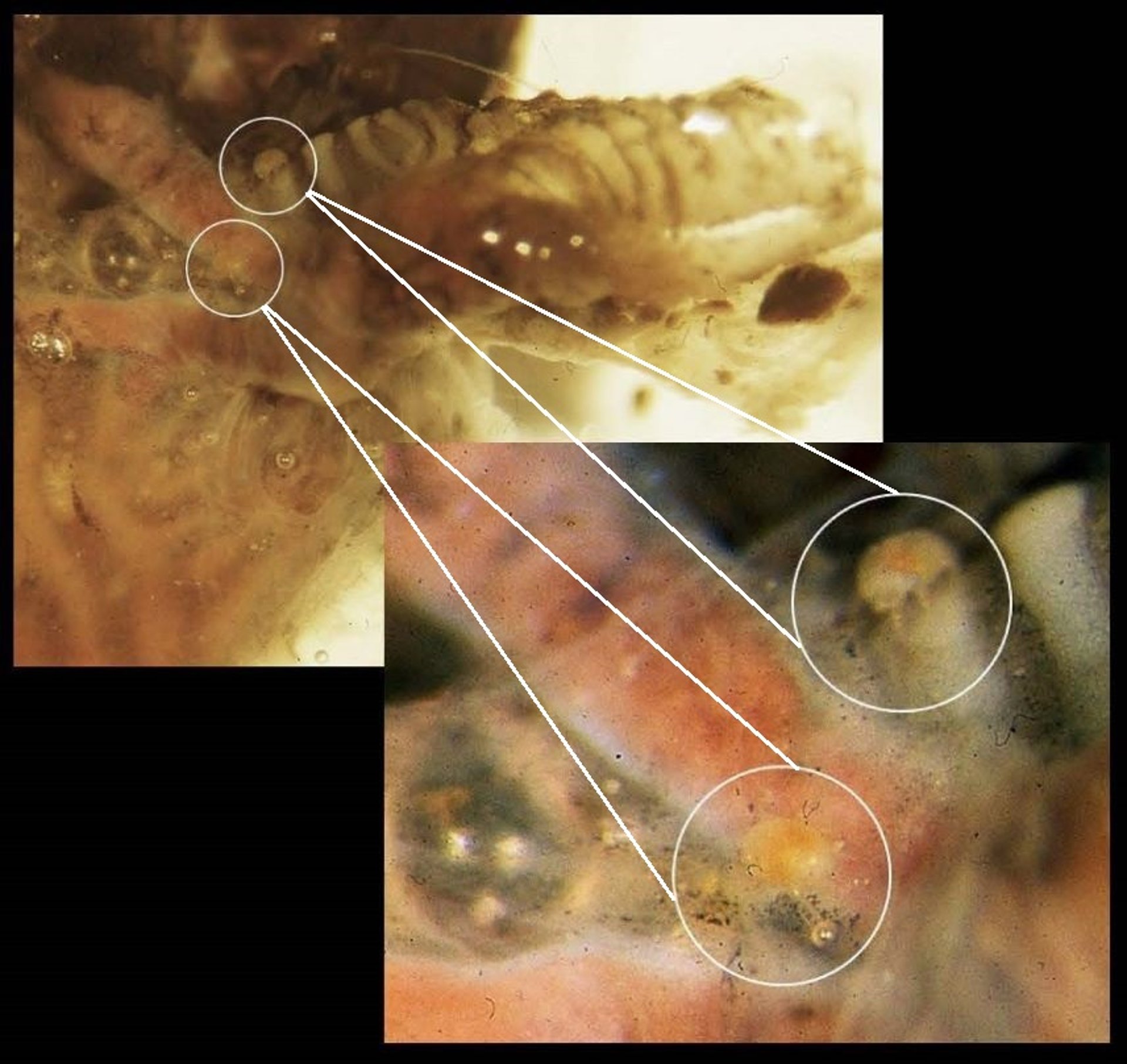
Cytodites sp mites (circled) in the air sac of a dissected specimen of a fantail (Rhipidura albiventris).
Courtesy of Dr. Barry OConnor.
Cytodites mites are readily transmissible between birds through coughing. They are rarely found in commercial industries. Their 14- to 21-day life cycle involves a larval stage and two nymphal stages.
Infestation densities of Cytodites mites vary, and clinical signs of infestation in birds range from none to weakness, weight loss, pneumonia, peritonitis, pulmonary edema, and death.
Euthanasia of infected birds is the best means of controlling air sac mites.
Another recommended treatment is ivermectin; however, note that the use of ivermectin is extralabel drug use (ELDU), so it must be prescribed by a veterinarian and must have documented approval from the US Food Animal Residue Avoidance Databank (FARAD). The established toxic dose of ivermectin in poultry is 5.4 mg/kg.
Inhalation by birds of an insecticidal dust such as pyrethrin or permethrin can also be effective against air sac mites. For more information, see the list of pesticides for treating poultry arthropods registered by state jurisdiction.
For More Information
Mullen GR, OConnor BM. Mites (Acari). In: Mullen GR, Durden LA, eds. Medical and Veterinary Entomology. 3rd ed. Academic Press; 2019:533-602.
Also see pet owner content regarding air sac mites in birds.