More than 30,000 species of spiders have been identified worldwide. However, only a small number of them are capable of medically consequential bites.
Almost all spiders are venomous, with the exception of spiders from family Ulobiridae (cribellate orb weavers or hackled orb weavers) and Symphytognathidae (dwarf orb weavers). However, only a few spiders possess the attributes necessary to cause clinical envenomation in mammals — mouth parts of sufficient size to allow penetration of the skin and toxin of sufficient quantity or potency to result in morbidity.
Two genera of spiders capable of harmful bites have a worldwide distribution: Latrodectus (widow spiders) and Loxosceles (commonly known as recluse, fiddle-back, or violin spiders) (1, 2).
Spiders have 4 pairs of segmented legs and 2 body compartments, the cephalothorax and the abdomen. Venom glands are located in the cephalothorax. Envenomation occurs via the injection of venom through fangs (3).
Spiders of medical importance in the US do not inflict particularly painful bites, so it is unusual for a spider bite to be suspected until clinical signs appear. It is also unlikely that the spider will remain in proximity to the victim for the length of time required for clinical signs to develop (30 minutes to 6 hours).
Spiders in the US capable of causing clinical envenomation belong to two groups: widow spiders (Latrodectus spp) and recluse or violin spiders (mostly Loxosceles spp).
In Europe, the species of medical importance are the European black widow (Latrodectus tredecimguttatus) and the Mediterranean recluse (Loxosceles rufescens).
In Australia, there is a plethora of venomous species of medical importance, including the Australian red-back spider (Latrodectus hasselti), the Australian funnel-web spiders (classified into two genera: Atrax and Hadronyche, the most toxic of which is Atrax robustus, the Sydney funnel-web spider), and the mouse spiders (genus Missulena) (4).
Spiders bites in Africa are less studied; however, the most medically important spider species are the black and brown button spiders (Latrodectus spp) (5), sac spiders (Cheiracanthium spp), and violin spiders (Loxosceles spp).
In South and Central America, the spiders of medical importance are those from the genus Phoneutria (especially the Brazilian wandering spider), Latrodectus, and Loxosceles.
The epidemiological situation associated with spiders in Asia is not well known. Available information suggests that the spider species of medical importance are those from the genus Lactrodectus (widow spiders) (1).
Recluse Spider (Loxosceles spp) Bites to Animals
Recluse spiders have a wide distribution in the temperate and tropical regions of the world. They are nocturnal and reclusive animals (hence, the name “recluse”) and therefore seldom observed. They can be found in undisturbed places in and around buildings, and they make irregular white webs.
Species within the genus Loxosceles range from dark brown to pale yellow, and they have 6 eyes arranged in pairs (dyads) (1) (see brown recluse spider image).
Recluse spiders are commonly called violin spiders because of the fiddle-shaped marking on the dorsal face of the cephalothorax (6). They are shy and do not bite unless they are disturbed and unable to escape (1). These arachnids are more active in the warmer months (7).
The diagnosis of recluse spider envenomation requires consideration of geographical location, clinical signs, and, ideally, identification of the spider (7).
Pearls & Pitfalls
|
Recluse Spider Species of Medical Interest
The most medically important species in the US is the brown recluse spider (Loxosceles reclusa). In the US, L reclusa is primarily distributed in central and southern states, ranging from central Texas to Kansas east through Missouri to Kentucky, Tennessee, Alabama, and Georgia, and in parts of Nebraska, Illinois, Kentucky, Iowa, Indiana, and Ohio (7) (see ).


Distribution of brown recluse spider (Loxosceles reclusa) in the US.
Courtesy of Richard S. Vetter.
The gaucho spider (Loxosceles gaucho) is endemic to South America, especially Brazil. The Chilean recluse spider (Loxosceles laeta) is native to South America. However, it has also been reported in Australia. The Mediterranean recluse spider (Loxosceles rufescens) is native to Europe and Western Asia but today has a global distribution. Loxosceles rufipes is native to Central and South America, while Parram's violin spider (Loxosceles parrami) is endemic to South Africa (8).
Recluse Spider Venom
The venom of recluse spiders is a complex mixture of enzymes and glycoproteins containing several necrotizing enzymes, including the phospholipase sphingomyelinase D, which is the main dermonecrotic factor. This enzyme activates the complement system and induces platelet aggregation and microvascular thrombosis, leading to tissue necrosis. Sphingomyelinase D also attracts and activates polymorphonuclear neutrophils, and the release of cytotoxic enzymes by these cells contributes to the necrotic lesions.
Recluse spider venom also has a hemolytic effect and depletes several clotting factors, causing prolonged coagulation time. However, it is not likely to cause coagulopathy.
Other enzymes found in recluse spider venom include hyaluronidase, esterases, collagenases, ribonucleases, deoxyribonucleases, and alkaline phosphatases (3, 7).
Clinical Signs of Recluse Spider Bites
Recluse spider bites cause local and systemic signs. The bite of recluse spiders is painless. Hence, the spider is typically not observed, and the bite is not witnessed in most cases.
Pearls & Pitfalls
|
Animals are usually bitten when they trap and accidentally compress the spider between their body and a surface (6).
Initially, a small area of erythema and pruritus can develop at the recluse spider bite location. Within 2–8 hours after the bite, a blister develops, which progresses to form a target or “bull’s-eye” lesion. The center of the bite can appear pale, ischemic, or cyanotic and progressively become dark and necrotic. The vesicle can form an ulcer that enlarges to create an eccentric pattern with eschar formation, potentially extending to underlying tissues. These slow-healing ulcers can persist for months (6).
Systemic clinical signs of recluse spider bites are rare in companion animals. They can include fever, vomiting, weakness, leukocytosis, hemolytic anemia, hemoglobinuria, disseminated intravascular coagulation, myalgia, and pyrexia (3). It can take several days for severe signs to develop.
Treatment of Recluse Spider Bites
Treatment for recluse spider envenomation is supportive care. Antivenom (also called antivenin) is available for South American recluse spiders; however, for other recluse spider envenomations, there is no antivenom available in most countries, including the US (3).
Therapy of the local dermonecrotic lesions is the hallmark of the treatment protocol for recluse spider bites. General wound care is advised. In severe cases, wound debridement with Burrow’s solution and hydrogen peroxide followed by bandaging is necessary (3, 6). Wound management consists of cool compresses and immobilization. Surgical debridement is not recommended and often worsens the lesions.
Pearls & Pitfalls
|
Antimicrobials, especially in the case of secondary infection related to a recluse spider bite, should be administered.
Pain management using NSAIDs might be necessary.
Dapsone, a leukocyte inhibitor, is commonly used in humans for recluse spider bites. It has been shown to be effective experimentally in dogs (3, 6), and dapsone-treated guinea pigs also showed smaller skin lesions than control animals in response to venom injection (8).
There is limited data to support the use of glucocorticoids in these cases.
Hyperbaric oxygen therapy has been suggested to improve wound healing.
Skin grafts have been used to treat recluse spiders bites; however, they are difficult to maintain and can repeatedly fail until the area of necrosis has become clearly demarcated.
Complete healing of a recluse spider bite might take weeks to months.
Although rare, systemic signs of recluse spider bites are potentially lethal. These animals should be hospitalized and treated for potential coagulation defects and anemia. Fluid therapy to maintain hydration and renal function, analgesics, and antipyretics can be useful (6).
Tarantula Bites to Animals
Tarantulas are hairy spiders from the family Theraphosidae, with more than 1,000 species worldwide (see ).


Tarantula. Note the presence of urticating hair on the abdomen.
Courtesy of Dr. Andrei Daniel Mihalca, University of Agricultural Sciences and Veterinary Medicine Cluj-Napoca.
Commonly sold in the pet trade, tarantulas have an increased presence in homes, where exposure to other pets can occur. Despite this, envenomation is rare, because most tarantulas do not use venom to kill their prey. Tarantula species found in the US are harmless and not aggressive, whereas Asian and some African species can cause a painful bite with localized edema.
The primary medical concern with tarantulas is the fine hairs on their back, which can be expelled as a defense mechanism. The hairs can lodge in an animal's cornea or cause dermal or mucosal irritation, potentially leading to allergic reactions or severe damage to the eye, including blindness. Treatment of these exposures involves management of any allergic response, removal of hairs from the cornea, and provision of supportive care.
Several genera of tarantulas from the tropical regions of South America, Africa, and Australia are capable of delivering a potentially life-threatening bite (3). The venom of these species contains a neurotoxin, and it can also contain toxins with necrotic and hemolytic effects. After envenomation, animals can experience muscle spasms, edema, hemoglobinuria, icterus, and circulatory shock. Symptomatic and supportive care measures should be implemented in these situations (3).
Widow Spider Bites to Animals
Widow spiders (Latrodectus spp) are the most medically important spiders. They have a worldwide distribution, typically living in tropical and temperate areas.
Widow spiders are small to medium size, with long, thin legs. They have a globular abdomen and a comparatively small cephalothorax. Female widow spiders range 8–13 mm in length, while males are 3 mm in length (9).
Widow spiders are cosmopolitan in urban environments; in nature, they prefer dry habitats.
The syndrome induced by any Latrodectus spp envenomation is called latrodectism (10). In veterinary medicine, most cases are reported in dogs and cats. However, several outbreaks of latrodectism have been described in livestock and horses in southern Russia, Spain, and Chile (2).
Widow Spider Species of Medical Interest
Numerous species within the genus Latrodectus are found throughout the Americas, Africa, Europe, Asia, and Australasia (10).
In North America, the most common species is the black widow spider (Latrodectus mactans) (see ). Female black widow spiders are larger than males and have a characteristic red or orange hourglass marking on the ventral abdomen. Immature females might not have the hourglass marking. However, they can still cause envenomation. Male black widow spiders pose minimal medical risk because their jaws are too small to penetrate mammalian skin (11).


Black widow spider (Latrodectus spp). Note the bright red spots on the ventral surface of the abdomen.
Courtesy of Dr. Andrei Daniel Mihalca, University of Agricultural Sciences and Veterinary Medicine Cluj-Napoca.
Other species found in the US include the western black widow (Latrodectus hesperus) in the western states; the red widow (Latrodectus bishopi) in the south; the northern widow (Latrodectus variolus) in the Midwest, eastern US, and southern Canada; and the brown widow (Latrodectus geometricus), found in Florida.
Medically important widow spiders species around the world include the following:
The Mediterranean black widow or European black widow (Latrodectus tredecimiguttatus) is found in Europe and Asia (1).
The brown widow spider (Latrodectus geometricus) has a cosmopolitan distribution; however, it is native to Africa (1).
The Australian redback spider (Latrodectus hasselti) is found in Australia and is considered a highly venomous widow spider.
Latrodectus katipo is endemic to New Zealand and is closely related to L hasselti.
Latrodectus indistinctus is primarily found in Namibia and South Africa (12).
The South American black widow (Latrodectus curacaviensis) is present in the Lesser Antilles and South America (1).
Latrodectus corralinus, Latrodectus quartus, Latrodectus mirabilis, and Latrodectus variegatus are found in Central and South America (1).
Black Widow Spider Venom
The venom of Latrodectus spp is a complex mixture (11).
The major toxic components of black widow spider venom are a variation of a neurotoxic protein, latrotoxin (8). The neurotoxin α-latrotoxin is the main component of the venom. It causes the selective release of neurotransmitters at synaptic junctions that trigger contraction of voluntary muscles (2). A large release of acetylcholine, norepinephrine, dopamine, glutamate, and enkephalins depletes these neurotransmitters, leading to blockage of neurotransmission and inhibition of reuptake.
Venom from a black widow spider is one of the most potent toxins by volume, and a single bite can deliver a deadly dose to companion animals. However, the spider can control the amount of venom released, and a small number of bites result in no envenomation.
Canids have some resistance to black widow spider toxin; however, guinea pigs, cats, and horses are highly susceptible.
Clinical Signs of Black Widow Spider Bites
Disease induced by black widow venom is called latrodectism (3).
Cats are highly vulnerable to the black widow spider envenomation, and fatal outcomes occur frequently (11).
Evidence of a black widow spider bite can be difficult to find in animals; however, the initial bite is painful. Mild erythema can be noted at the bite location. This does not cause local tissue damage. Myalgia and muscle cramps occur near the site of envenomation 1–2 hours after the bite, and symptoms spread to larger muscle groups (3).
Other clinical signs of black widow spider envenomation include agitation, vomiting, diarrhea, severe pain secondary to muscle cramping, muscle fasciculations, and tremors. Abdominal rigidity without tenderness can indicate envenomation. In severely symptomatic patients, hypertension, respiratory distress, and partial paresis can occur.
Onset of clinical signs can occur within minutes after a black widow spider bite; however, more severe symptoms can be expected within 8 hours. These signs can wax and wane over the next couple of days until they resolve.
Treatment of Black Widow Spider Bites
The overall prognosis of black widow envenomation is good in dogs, and many do not require medical treatment. Treatment of black widow envenomation in most cases is supportive care over several days to manage pain and muscle cramping.
Antivenom can hasten recovery in some patients; however, it might not be necessary and should be considered on a case-by-case basis. Loxosceles antivenoms are commercially available in Brazil, Argentina, Peru, and Mexico, and all are horse-derived F(ab´)2 antivenoms, apart from a whole IgG antivenom from Peru. Allergic reactions to the antivenom are possible, and anaphylaxis can occur (11). Caution during administration is indicated, and premedication with diphenhydramine should be considered.
Administration of opioids and benzodiazepines is the most common treatment for management of muscle cramping and pain from black widow envenomation. Muscle relaxants can also be helpful. In humans, calcium gluconate infusions are sometimes used to help with muscle pain; however, relief is generally short-lived and not as effective as opioids or benzodiazepines. As such, calcium gluconate is no longer recommended as a treatment for black widow envenomation in animals.
Pearls & Pitfalls
|
Brazilian Wandering Spider Bites to Animals
Although common in humans, Brazilian wandering spider (Phoneutria spp) bites to animals are rarely reported. Wandering spiders are nocturnal animals, and they attack if they are disturbed. Most bites in dogs involve the muzzle area (13).
Wandering spider venom contains several neurotoxic peptides acting on sodium, calcium, and TRPA channels (14).
Clinical signs include local pain, lateral recumbency, muscular fasciculation, salivation, dyspnea, mydriasis, and vomiting.
Treatment consists of fluid therapy and analgesics (13).
Scorpion Stings to Animals
Scorpions are distributed across tropical and temperate regions of the world.
The body of a scorpion consists of a cephalothorax (prosoma) and an abdomen (opisthosoma). The venom apparatus is located on the telson, the last segment of the metasoma, which ends in a stinger (aculeus) and contains two venom glands (9) (see ). The prominent stinger at the end of the dorsal abdomen is connected to the venom glands and is the scorpion's main defense mechanism.

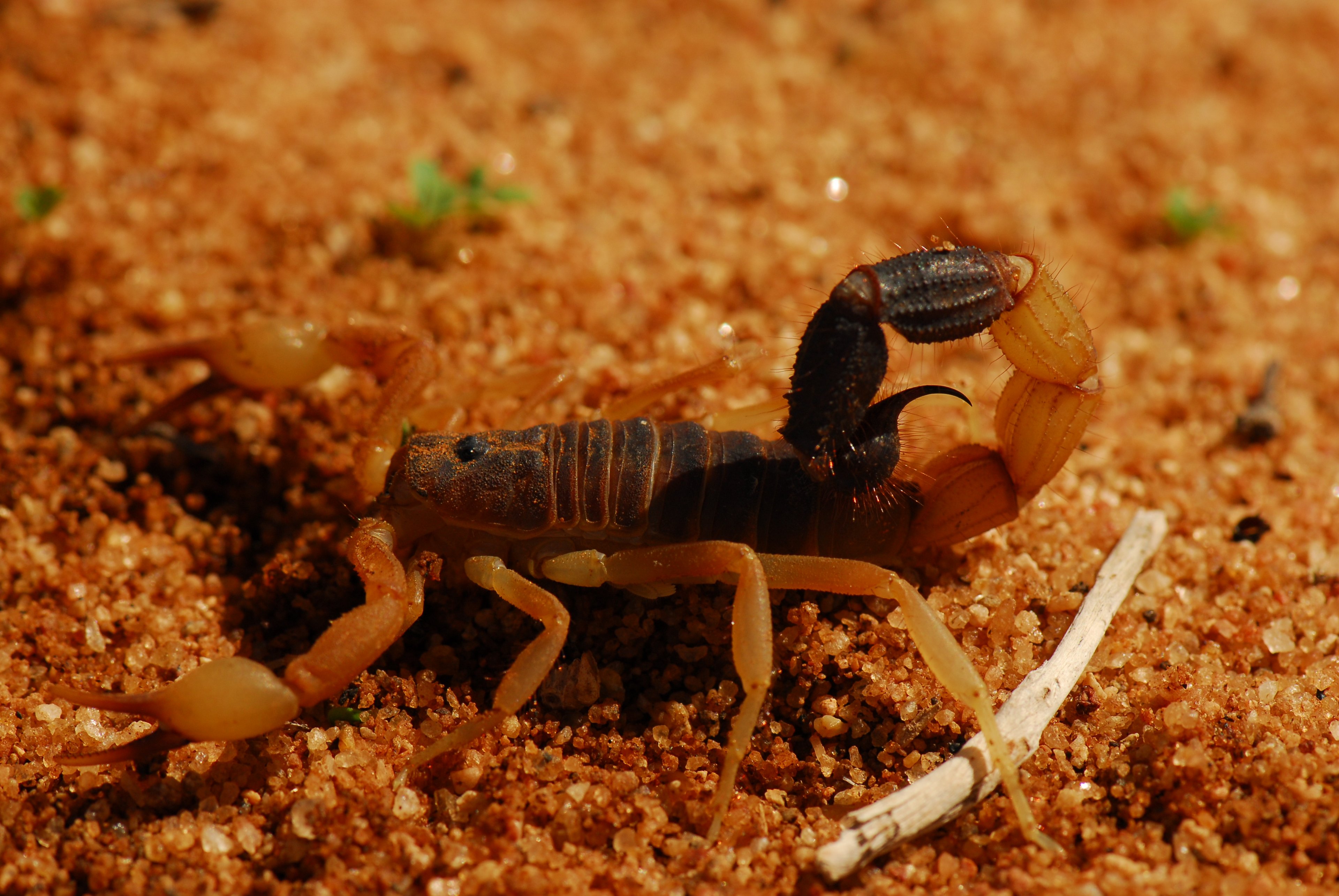
A scorpion. Note the stinger at the end of the telson.
Courtesy of Dr. Andrei Daniel Mihalca, University of Agricultural Sciences and Veterinary Medicine Cluj-Napoca.
Scorpion Species of Medical Interest
The species of scorpions found in the US are unlikely to cause envenomation in companion animals; however, a sting from a scorpion can be very painful.
While severe toxicity is not likely, the Arizona bark scorpion (Centruroides sculpturatus) causes more extensive systemic envenomation in some animals. These scorpions are found in Arizona, western New Mexico, southern Utah, and Nevada, and they can occasionally also be present along the Colorado River in California and in northwestern Mexico.
Other species of the Centruroides genus are present in Central and South America (9).
Medically important scorpion species are found around the world and include the following:
Thick-tailed scorpions (Tityus spp) are found in Central and South America and in the West Indies. The most well‑known species in this genus is the Brazilian yellow scorpion (Tityus serrulatus).
Leiurus spp are found in Northeastern Africa and the Middle East. The most common species, Leiurus quinquestriatus, is also known as the deathstalker.
Buthus spp can be found in Egypt, Ethiopia, Libya, Israel, Jordan, southern Spain, and southern France. The common yellow scorpion (Buthus occitanus) is a medically important species.
Fat-tailed scorpions (Androctonus spp) are found in North Africa, the Middle East, and southwestern Asia.
The Indian red scorpion (Hottentotta tamulus) is found on the Indian subcontinent.
Burrowing thick-tailed scorpions (Parabuthus spp) are found in South Africa (9).
Australian species are of little medical importance (15).
Scorpion Venom
The venom of scorpions is a complex mix of low-molecular-weight peptides that interfere with ion channels of the membranes of excitable cells (16).
Two important neurotoxins have been identified: α and β scorpiotoxin. α-scorpiotoxin is present in the venom of scorpions from the Androctonus, Leiurus, Tytius, and Hottentotta genera, while β-scorpiotoxin is present in the venom of Centruroides spp and Tytius spp (3).
There are long- and short-chain peptides in scorpion venom toxins. Long-chain peptides affect the sodium channels, while short-chain peptides block potassium channels of membranes of excitable cells (3, 16).
By blocking potassium and sodium channels, scorpion venom toxins inhibit neuromuscular transmission. Catecholamines and acetylcholine are released in large amounts, stimulating sympathetic and parasympathetic responses and leading to changes in heart rate and blood pressure.
Clinical Signs of Scorpion Stings
Clinical signs of scorpion stings vary by species, ranging from mild local pain to severe, life-threatening, systemic reactions.
In most canine patients, the sting of the Arizona bark scorpion (C sculpturatus) is often limited to localized pain (evidenced by pain response such as pawing, limping, or vocalization), edema, erythema, and pruritis. Sloughing of the skin at the sting site can also occur (3).
Systemic clinical signs of bark scorpion stings are not common; however, patients should be monitored for their development. The most common systemic signs are tachycardia and hypertension. Agitation, twitching, and hypersalivation can also occur. Pulmonary edema, secondary to the cardiac effects, can occur (17). Allergic reaction to the venom, characterized by swelling of the eyelids, tongue, and vomiting, is rare, though possible (3).
Stings by species from other genera of scorpions can cause more serious systemic clinical signs. For example, in humans, envenomation by the Indian red scorpion (Hottentotta tamulus) has a case-fatality rate of up to 40% in children.
Treatment of Scorpion Stings
Local wound care by washing the scorpion sting area and the use of cold compresses to decrease swelling should be instituted. Systemic signs can be managed with supportive care and administration of analgesics (17).
In the US, an equine-derived antivenom approved for use in humans is available for the treatment of severe systemic clinical signs of scorpion stings (especially in pediatric and geriatric patients). The antivenom is rarely used as a treatment modality in veterinary medicine, as it can be cost-prohibitive and must be administered shortly after the sting to reverse systemic effects (17). Around the world, numerous species-specific antivenoms (developed for human use) are available for the treatment of scorpion envenomation (16).
Key Points
A number of medically important spiders and scorpions are found in various regions worldwide.
Clinical signs depend on the type of envenomation.
Antivenom can hasten recovery in some patients.
For More Information
Mullen GR, Durden LA. Medical and Veterinary Entomology. 3rd ed. Academic Press; 2019.
White J, Meier J. Handbook of Clinical Toxicology of Animal Venoms and Poisons. CRC Press; 2008.
References
Lucas SM, Meier J, Biology and distribution of spiders of medical importance. In: White J, Meier J. Handbook of Clinical Toxicology of Animal Venoms and Poisons. CRC Press; 2008:131-142. doi:10.1201/9780203719442-19
Mullen GR, Vetter RS. Spiders. In: Mullen GR, Vetter RS, eds. Medical and Veterinary Entomology. 3rd ed. Elsevier; 2019:507-529. doi:10.1016/b978-0-12-814043-7.00025-x
Gwaltney-Brant SM, Dunayer E, Youssef H. Terrestrial zootoxins. In: Gupta RC, ed. Veterinary Toxicology. 3rd ed. Academic Press; 2018:781–801. doi:10.1016/b978-0-12-811410-0.00058-110.1016/C2016-0-01687-X
Nicholson GM, Graudins A. Spiders of medical importance in the Asia-Pacific: atracotoxin, latrotoxin, and related spider neurotoxins. Clin Exp Pharmacol Physiol. 2002;29(9):785-94. doi: 10.1046/j.1440-1681.2002.03741.x
Bird TL, van Rensburg R, Dippenaar-Schoeman AS. Medically important spider bites in southern Africa. S Afr Gen Pract. 2021;2(4):131-136. doi:10.36303/SAGP.2021.2.4.0088 (The DOI link for this source is invalid.)
Peterson ME. Brown spider envenomation. Clin Tech Small Anim Pract. 2006;21(4):191-193. doi:10.1053/j.ctsap.2006.10.004
Pace LB, Vetter RS. Brown recluse spider (Loxosceles reclusa) envenomation in small animals. J Vet Emerg Crit Care (San Antonio). 2009 Aug;19(4):329-336. doi:10.1111/j.1476-4431.2009.00440.x
White J, Cardoso JL, Fan HW, Clinical toxicology of spider bites. In: White J, Meier J. Handbook of Clinical Toxicology of Animal Venoms and Poisons. CRC Press; 2017. p.143-180. doi:10.1201/9780203719442-20
Lucas SM, Meier J. Biology and distribution of scorpions of medical importance. In: White J, Meier J, Handbook of Clinical Toxicology of Animal Venoms and Poisons. CRC Press; 2008:114-119. doi:10.1201/9780203719442-17
Isbister GK, Fan HW. Spider bite. Lancet. 2011;378(9808):2039-2047. doi:10.1016/S0140-6736(10)62230-1
Peterson ME. Black widow spider envenomation. Clin Tech Small Anim Pract. 2006;21(4):187-190. doi:10.1053/j.ctsap.2006.10.003
World Spider Catalog. Latrodectus indistinctus O. Pickard-Cambridge, 1904. Accessed January 20, 2026.
Fernandes HS, Sakate M, Cherubini AL, Padovani AF, Meneses AMC, Spider envenoming of dog - case report. J Venom Anim Toxins. 2002;8(1). doi:10.1590/S0104-79302002000100014
Peigneur S, de Lima ME, Tytgat J. Phoneutria nigriventer venom: A pharmacological treasure. Toxicon. 2018;151:96-110. doi:10.1016/j.toxicon.2018.07.008
Isbister GK, Volschenk ES, Seymour JE. Scorpion stings in Australia: five definite stings and a review. Intern Med J. 2004;34(7):427-430. doi:10.1111/j.1445-5994.2004.00625.x
Dehesa-Davila M, Alagon AC, Possani LD. Clinical toxicology of scorpion stings. In: White J, Meier J, Handbook of Clinical Toxicology of Animal Venoms and Poisons. CRC Press; 2008:120-130. doi:10.1201/9780203719442-18
Peterson ME. Scorpions In: Hovda LR, Brutlag AG, Poppenga RH, Epstein SE, eds. Blackwell's Five-Minute Veterinary Consult Clinical Companion: Small Animal Toxicology, 3rd ed. Wiley-Blackwell; 2024:428-432.