Some diseases of the pinna in dogs and cats occur sporadically, do not affect the pinna solely, are poorly understood, or do not require much in terms of treatment. Many of these diseases require careful history taking (including recent and current medications), cytological evaluation to rule out secondary infection, and skin biopsy to make a definitive diagnosis. Management is variable and depends on the disease.
Immune-Mediated Diseases Affecting the Pinna in Dogs and Cats
The following immune-mediated diseases can affect the pinna and ear canal in dogs and cats:
pemphigus complex (including pemphigus foliaceus [see ] and pemphigus erythematosus)
drug eruption
erythema multiforme
toxic epidermal necrolysis
immune-mediated vasculitis

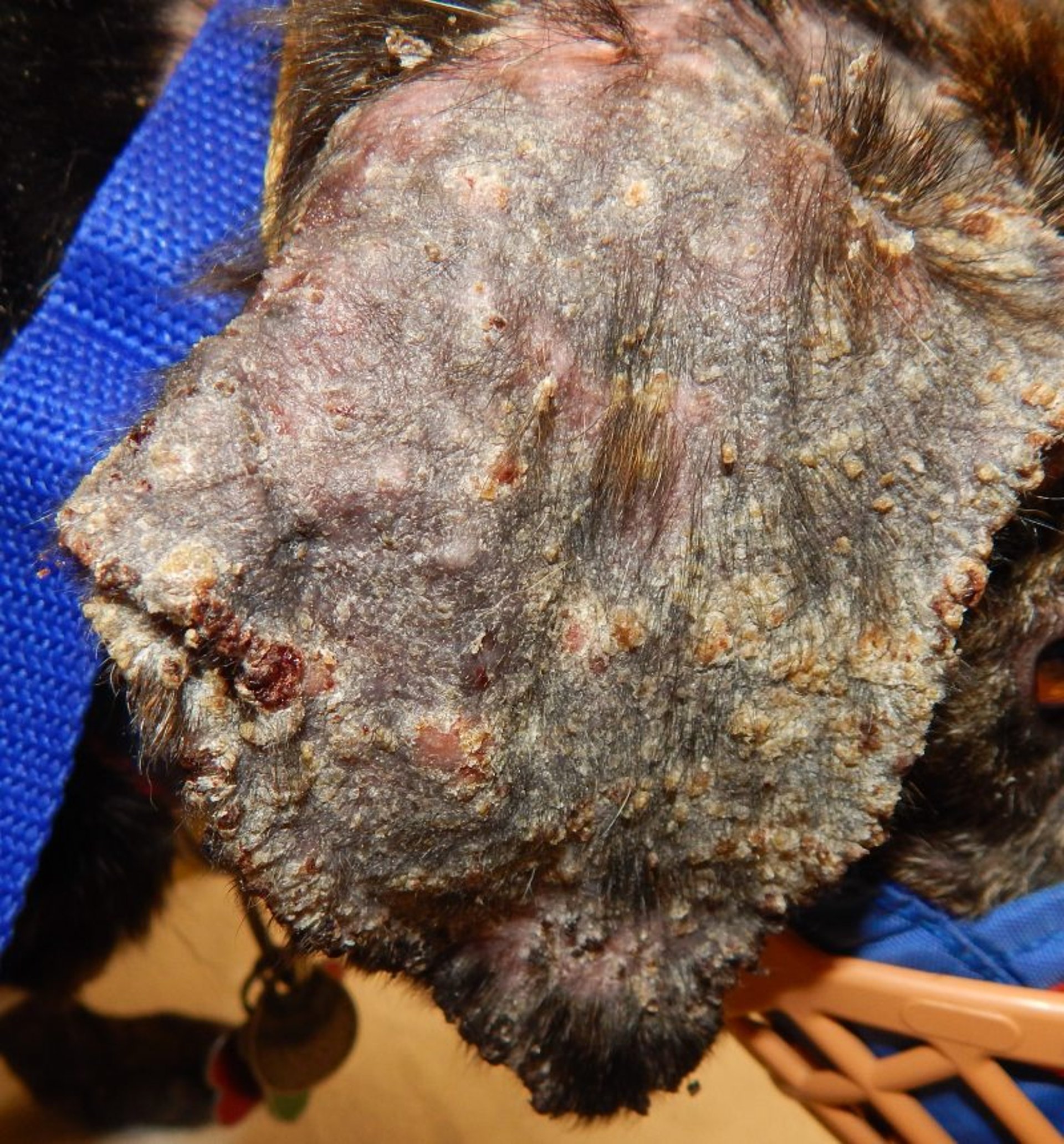
Alopecia, crusts, and scale adhered to the convex aspect of the pinna in a dog with pemphigus foliaceus.
Courtesy of Dr. Lara Tomich.
Also see Autoimmune Skin Diseases.
Folded Ear Tips in Cats
Folded ear tips in cats (see ) are most often associated with long-term glucocorticoid therapy (eg, daily eye or otic preparations). They can also be caused by solar radiation damage. Ear folding might not be reversible.


Folded ear tips associated with long-term glucocorticoid therapy in a cat.
Courtesy of Dr. Pascal Prélaud.
Cats with this condition are not to be confused with breeds genetically predisposed to a folded ear tip, such as the Scottish Fold, American Fold, Munchkin, Highlander, or Elf Cat.
Feline Solar Dermatitis Affecting the Pinna
Feline solar dermatitis, or actinic dermatitis, occurs most often in white cats or in cats with white pinnae that have been chronically exposed to sun. Lesions first appear as erythema and scaling on the sparsely haired ear tips. Crusting, exudation, and ulceration can develop as the actinic keratosis undergoes transformation into squamous cell carcinoma.
During the early stages of feline solar dermatitis, treatment consists of limiting exposure to UV light through confinement indoors between the hours of 10 am and 4 pm and the use of topical sunscreens.
Squamous cell carcinoma of the pinnae is treated with surgical excisionfollowed by radiation therapy. If surgery and radiation therapy are not an option, topical treatment with 5% imiquimod cream 2–3 times weekly has shown promising results; duration of treatment varies with each patient (1, 2).
Feline Proliferative and Necrotizing Otitis Externa
Feline proliferative and necrotizing otitis externa is a rare, immune-mediated disease affecting the ear canals and concave pinnae of cats and kittens. The etiopathogenesis has not been fully elucidated.
Affected cats range in age from 2 months to 12 years; most cases occur before the age of 4 years. No breed predilection has been reported; however, males appear to be overrepresented.
Feline proliferative and necrotizing otitis externa most often affects the concave aspect of the pinna and external aural orifice; however, it can extend into the ear canal. The preauricular, periocular, and perioral regions can also be affected.
Lesions are characterized by thick hyperkeratotic crusts covering erythematous plaques that can erode or ulcerate (see ). Secondary bacterial and yeast infections can aggravate the condition. Most cats appear indifferent to the lesions; however, mild pruritus and discomfort sometimes occur when ulceration develops.

Proliferative and ulcerative lesion localized to the concave aspect of the pinna in a cat with feline proliferative and necrotizing otitis externa.
Courtesy of Dr. Elizabeth Mauldin.
Diagnosis of feline proliferative and necrotizing otitis externa is confirmed by histopathological findings, which are characterized by epidermal hyperplasia associated with scattered apoptotic keratinocytes that extend to the superficial follicular epithelium. Parakeratotic hyperkeratosis is also a feature.
Spontaneous resolution has occurred in some cases, but only after 12–24 months (3).
Several treatment options are available for proliferative and necrotizing otitis externa in cats.
Tacrolimus (0.1% ointment, topically, every 12–24 hours until clinical resolution [3 weeks to 5 months]) has been reported to be effective, both as a standalone topical therapy and in combination with otic formulations containing antibacterial, antifungal, and corticosteroid agents (4, 5, 6, 7).
Cyclosporine (5 mg/kg, PO, every 24 hours until clinical resolution [1–6 weeks]) has been reported to be efficacious (8).
Several case reports describe successful treatment of refractory proliferative and necrotizing otitis externa using oclacitinib (0.5–1.5 mg/kg, PO, every 12–24 hours for several weeks after clinical resolution [several weeks to months]) (9, 10, 11).
Proliferative Thrombovascular Necrosis of the Pinna in Dogs
Proliferative thrombovascular necrosis is a cutaneous vascular perfusion disorder that affects the pinna in dogs. The cause is unknown. In one reported case, thromboischemic pinnal necrosis was associated with fenbendazole treatment (12).
Proliferative thrombovascular necrosis is rare in dogs. There are no known breed, sex, or age predilections.
Clinical signs of proliferative thrombovascular necrosis consist of scaly, thickened, hyperpigmented skin surrounding a necrotic ulcer. Lesions begin at the apex of the ear and spread along the concave surface. Eventually, necrosis can deform the pinnal margin.
Histopathological lesions of proliferative thrombovascular necrosis are characterized by arteriolar proliferation, sclerosis, hyaline degeneration, and thrombosis. Vasculitis is absent.
Treatment is often for the life of the patient; however, the dose or frequency can sometimes be decreased from the initial dosage once the condition is in remission. Treatment with pentoxifylline (15–20 mg/kg, PO, every 8–12 hours until remission, then tapered to lowest effective dose)has been anecdotally reported as efficacious in some cases (13, 14). A case series suggests that oclacitinib (0.4–0.6 mg/kg, PO, every 12–24 hours until remission, then tapered to lowest effective dose) might also be effective (15). Topical glucocorticoids are also an option but must be used carefully because of their potential to cause thinning of the already thin pinnal skin.
If medical treatment of proliferative thrombovascular necrosis is unsuccessful, surgical removal of diseased tissue should be considered.
Auricular Chondritis in Dogs and Cats
Auricular chondritis is an immune-mediated condition characterized by inflammation and deformation of the auricular cartilage.
Auricular chondritis is rare in both cats and dogs.
Clinical signs include pain, swelling, erythema, and deformation of the pinna (see ). Typically, both ears are affected. Systemic clinical signs occur in some cases, and involvement of other organs (eg, joints, eyes, heart) has been reported, similarly to relapsing polychondritis in humans.


Ear of a cat with auricular chondritis. Note how the pinna is erythematous and thickened, resulting in curvature of the margins.
Courtesy of Dr. Jan Declercq.
Histopathological lesions of auricular chondritis include lymphoplasmacytic infiltrates, basophilia, and loss or necrosis of cartilage.
Treatment might not be required if the condition is nonpainful and no systemic signs are present. In one reported case, clinical resolution occurred following treatment with prednisolone (3 mg/kg, PO, every 24 hours, then slowly tapered and discontinued), without relapse within 18 months (16). Use of dapsone (1 mg/kg, PO, every 24 hours), with or without concurrent glucocorticoid therapy, has also been reported in cats; however, adverse effects are possible (17).
Pinnectomy is another treatment option for patients in whom medical management with prednisolone and/or dapsone has been unsuccessful (17).
Given the small number of reported cases and the fact that some cases resolve without treatment, the role of treatment in the course of disease remains unclear.
Permanent deformity of the pinnae is to be expected with auricular chondritis, whether or not treatment has been instituted.
Cutaneous Vasculitides Affecting the Pinna in Dogs and Cats
Vasculitis is not a specific diagnosis but refers to inflammation of blood vessel walls. Vasculitides can manifest as systemic disease with or without cutaneous involvement or can be localized to the skin (or other organs). It is usually difficult to determine the triggering cause of vasculitis, which can be immune-mediated, drug-induced, secondary to an infectious agent, paraneoplastic, or idiopathic.
Vasculitis is uncommon in dogs and cats.
In cases of cutaneous vasculitides, lesions include purpura, erythema, well-demarcated ulcers, crusts, and sloughing of necrotic tissue (see ). The pinnae, tail, and footpads are the parts of the body typically affected.

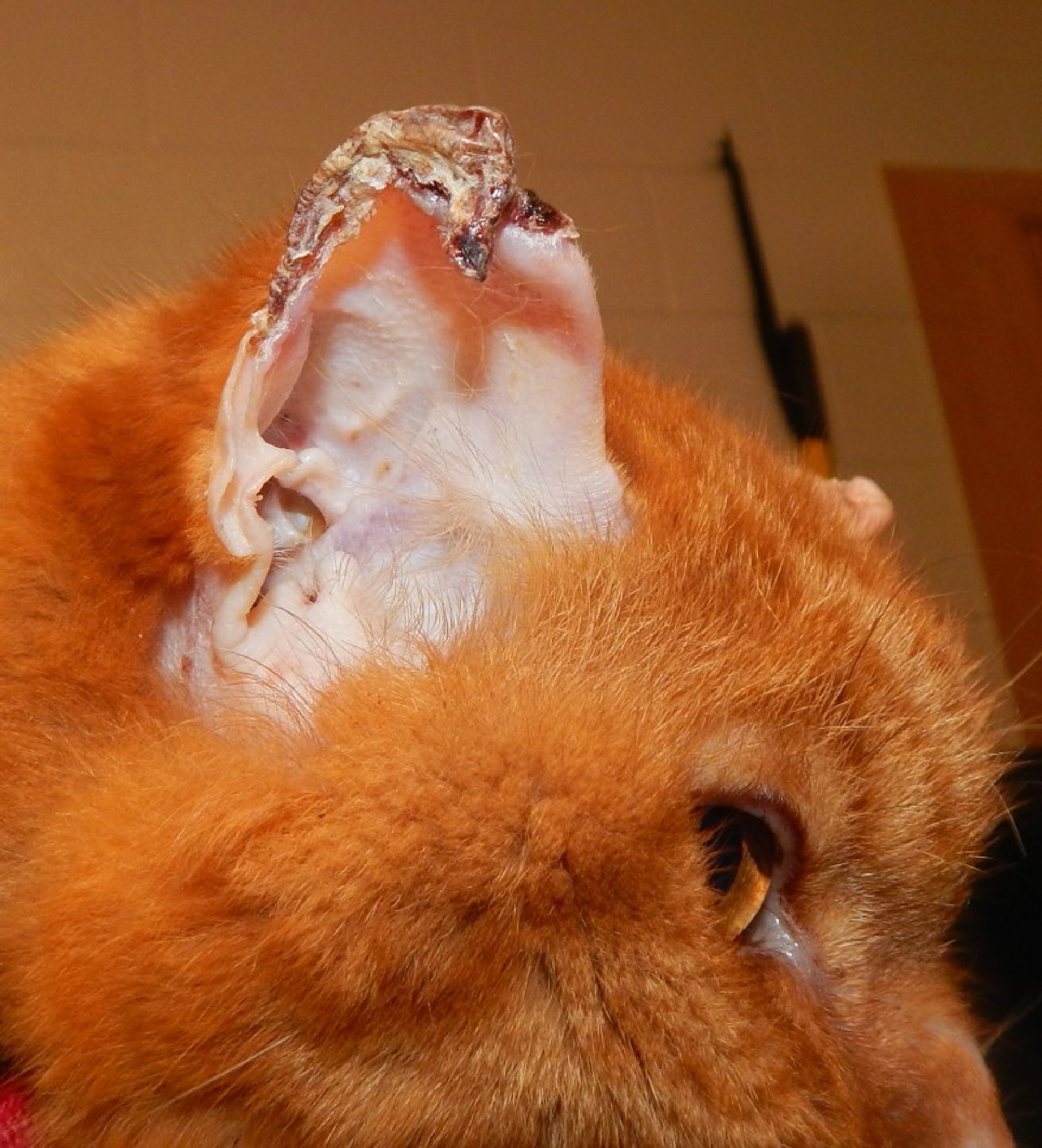
Crusting and necrosis of distal margin of the pinna caused by vasculitis in a cat.
Courtesy of Dr. Lara Tomich.
Differential diagnoses for cutaneous vasculitis include fight wounds, cold agglutinin diseases, frostbite, and coagulopathies.
Treatment of vasculitis involves identifying and eliminating the inciting cause, if possible. Athough this sometimes leads to resolution, systemic immunomodulatory therapy is often required. Generally, systemic immunomodulatory therapy is continued until clinical resolution, then tapered to the minimum effective dose and frequency, depending on the clinical signs and response to treatment. Patients must be monitored for relapse before discontinuation.
Options for initiation of systemic immunomodulatory therapy for vasculitis include the following:
short-acting glucocorticoids, such as prednisone or prednisolone (1–2 mg/kg, PO, every 24 hours [18])
doxycycline (5 mg/kg, PO, every 12 hours) and niacinamide (250 mg, PO, every 8 hours for dogs < 10 kg; or 500 mg, PO, every 8 hours for dogs > 10 kg) (18)
pentoxifylline (15–20 mg/kg, PO, every 8–12 hours [19])
cyclosporine (5 mg/kg, PO, every 24 hours [18])
oclacitinib (0.4–0.6 mg/kg, PO, every 12−24 hours [15])
Frostbite Affecting the Pinna in Dogs and Cats
Frostbite can occur in dogs and cats that are poorly adapted to cold climates and is more likely in wet or windy conditions. Frostbite typically affects poorly insulated body regions, including the tips of the pinnae, the feet, and the tail.
Frostbitten skin can be pale or erythematous, edematous, and painful. In severe cases, necrosis and sloughing of the ear tips might follow.
Treatment of frostbite consists of rapid, gentle warming and supportive care. Amputation of affected regions might be required but should be delayed until the extent of viable tissue is determined, which can take some time.
Canine Juvenile Cellulitis Affecting the Pinna
Canine juvenile cellulitis (also called puppy strangles or juvenile sterile granulomatous dermatitis and lymphadenitis) is an uncommon disorder of dogs. The etiopathogenesis is not fully elucidated; however, the condition is thought to arise from immune dysregulation. It typically affects puppies 3 weeks to 4 months old and rarely older animals.
Canine juvenile cellulitis is characterized by sterile papules, nodules, and pustules. Areas commonly affected are the face (especially the periocular skin and muzzle) and pinnae (see ). In addition, mandibular lymphadenomegaly also commonly occurs. A purulent otitis externa is common, along with edematous, thickened pinnae. Systemic signs such as anorexia, lethargy, and fever can be present.

Dog with canine juvenile cellulitis. Note the multifocal to coalescing, erythematous papules and pustules on the face, including the muzzle, periocular skin, and pinnae. Note also the swelling under the chin due to mandibular lymph node enlargement.
Courtesy of Dr. Sheila Torres.
Although any dog breed can be affected by juvenile cellulitis, the following breeds are at higher risk:
Golden Retriever
Gordon Setter
Dachshund
Diagnosis of canine juvenile cellulitis can be confirmed by biopsy results, which show a pyogranulomatous inflammatory infiltrate with no microorganisms, and by negative bacteriological culture result.
Once a diagnosis is made, treatment with immunosuppressive doses of prednisone or prednisolone (2 mg/kg, PO, every 24 hours; or 1 mg/kg, PO, every 12 hours) should be initiated to avoid scarring. The treatment should be tapered slowly over 4–6 weeks or until the disease is inactive (20). Antimicrobials may be administered to treat secondary bacterial infection. Cyclosporine (5–6 mg/kg, PO, every 24 hours until resolution, then slowly tapered over weeks to months) has been reported to be effective in a case refractory to glucocorticoid therapy (21, 22).
For More Information
Brame BE. Proliferative and necrotizing otitis externa of cats and kittens. Vet Clin North Am Small Anim Pract. 2025;55(2):337-361.
Also see pet owner content regarding outer ear disorders in dogs and cats.
References
Gill VL, Bergman PJ, Baer KE, Craft D, Leung C. Use of imiquimod 5% cream (Aldara) in cats with multicentric squamous cell carcinoma in situ: 12 cases (2002-2005). Vet Comp Oncol. 2008;6(1):55-64. doi:10.1111/j.1476-5829.2007.00144.x.
Peters-Kennedy J, Scott DW, Miller WH. Apparent clinical resolution of pinnal actinic keratoses and squamous cell carcinoma in a cat using topical imiquimod 5% cream. J Feline Med Surg. 2008;10(6):593-599. doi:10.1016/j.jfms.2008.02.002
Banovic F, Gomes P, Trainor K. Feline immune-mediated skin disorders: part 2. J Feline Med Surg. 2025;27(4):1098612X251323424. doi:10.1177/1098612X251323424
Mauldin EA, Ness TA, Goldschmidt MH. Proliferative and necrotizing otitis externa in four cats. Vet Dermatol. 2007;18(5):370-377. doi:10.1111/j.1365-3164.2007.00614.x
Stevens BJ, Linder KE. Pathology in practice. Proliferative and necrotizing otitis externa. J Am Vet Med Assoc. 2012;241(5):567-569. doi:10.2460/javma.241.5.567
Borio S, Massari F, Abramo F, Colombo S. Proliferative and necrotising otitis externa in a cat without pinnal involvement: video-otoscopic features. J Feline Med Surg. 2013;15(4):353-356. doi:10.1177/1098612X12468838
Vidémont E, Pin D. Proliferative and necrotising otitis in a kitten: first demonstration of T-cell-mediated apoptosis. J Small Anim Pract. 2010;51(11):599-603. doi:10.1111/j.1748-5827.2010.00999.x
Tjalsma E, Meertens N. Proliferative necrotizing otitis externa in two young cats. Vlaams Diergeneeskd Tijdschr. 2023;92(1):17-21. doi:10.21825/vdt.85859
Chan T, Koch SN, Devine S, Mendoza‐Kuznetsova E. Oclacitinib therapy in two cats with refractory proliferative and necrotising otitis externa. Vet Dermatol. 2024;35(5):568-572. doi:10.1111/vde.13269
Koch SN, Torres SMF. Severe proliferative necrotising otitis externa with extra-auricular involvement in a young cat successfully treated with oclacitinib maleate after incomplete response to prednisolone. NAVDF congress abstracts. Vet Dermatol. 2023;34:249-265. doi:10.1111/vde.13182
Chee T, Robson D. Proliferative necrotising otitis externa in a cat treated successfully with oclacitinib maleate with two delayed relapses. Vet Med Sci. 2025;11(6):e70696. doi:10.1002/vms3.70696
Nuttall TJ, Burrow R, Fraser I, Kipar A. Thrombo-ischaemic pinnal necrosis associated with fenbendazole treatment in a dog. J Small Anim Pract. 2005;46(5):243-246. doi:10.1111/j.1748-5827.2005.tb00317.x
Griffin C. Dermatologic diseases of the auricle. In: World Small Animal Veterinary Association World Congress Proceedings, 2006. World Small Animal Veterinary Association; 2006.
Pentoxifylline. Plumb’s Veterinary Drugs. https://plumbs.com
Colombo S, Cornegliani L, Vercelli A, Fondati A. Ear tip ulcerative dermatitis treated with oclacitinib in 25 dogs: A retrospective case series. Vet Dermatol. 2021;32(4):363. doi:10.1111/vde.12992
Delmage DA, Kelly DF. Auricular chondritis in a cat. J Small Anim Pract. 2001;42(10):499-501. doi:10.1111/j.1748-5827.2001.tb02457.x
Gerber B, Crottaz M, von Tscharner C, Schärer V. Feline relapsing polychondritis: two cases and a review of the literature. J Feline Med Surg. 2002;4(4):189-194. doi:10.1053/jfms.2002.0170
Innera M. Cutaneous vasculitis in small animals. Vet Clin North Am Small Anim Pract. 2013;43(1):113-134. doi:10.1016/j.cvsm.2012.09.011
Morris DO. Ischemic dermatopathies. Vet Clin North Am Small Anim Pract. 2013;43(1):99-111. doi:10.1016/j.cvsm.2012.09.008
White SD, Rosychuk RA, Stewart LJ, Cape L, Hughes BJ. Juvenile cellulitis in dogs: 15 cases (1979-1988). J Am Vet Med Assoc. 1989;195(11):1609-1611.
Bajwa J. Juvenile cellulitis (juvenile sterile granulomatous dermatitis and lymphadenitis) in a 9-week-old puppy treated with prednisolone-cyclosporine combination therapy. Can Vet J. 2022;63(3):313-316.
Park C, Yoo JH, Kim HJ, Kang BT, Park HM. Combination of cyclosporin A and prednisolone for juvenile cellulitis concurrent with hindlimb paresis in 3 English cocker spaniel puppies. Can Vet J. 2010;51(11):1265-1268.