Mites are parasitic arachnids that infest domesticated animals worldwide and cause mange. Mite infestation affecting the pinna can result in head shaking, scratching at the ears, crusting, and hair loss. Diagnosis is based on a thorough history, physical examination, superficial skin scrapings, and response to treatment. Treatment involves application or administration of acaricides to both the patient and other animals in contact with the patient for the duration of two life cycles of the mite.
Mange is a common dermatological condition that can affect the pinnae of animals. It is caused by infestation with parasitic mites. Sarcoptes scabiei is a common mange mite in pigs and dogs, and Notoedres cati is common in cats throughout the world. In the US, sarcoptic mange (scabies) is rare in horses and sheep and is a reportable disease. Nonburrowing psoroptic mites (Psoroptes spp) cause otitis externa in horses, sheep, and goats.
Transmission of mites is by direct contact with infested animals or contaminated fomites.
Clinical Findings of Mite Infestations Affecting the Pinna
Clinical signs of mite infestation affecting the pinna include severe pruritus, characterized by head shaking and scratching at the ears. Papules can occur as a primary dermatological lesion. Secondary dermatological lesions can include the following:
scaling
crusting (see and )
excoriations


Tightly adhered crusts along the ear margin in a case of sarcoptic mange in a dog.
Courtesy of Dr. Sheila Torres.


Severe crusting of the face and ear margins in a domestic shorthair cat with generalized infestation with Notoedres cati mites.
Courtesy of Dr. Sandra Diaz.
Horses and sheep can develop a drooping ear. Some patients infested with Psoroptes spp mites exhibit no clinical signs.
Diagnosis of Mite Infestations Affecting the Pinna
Diagnosis of mite infestation is based on the following:
clinical signs
history
physical examination (including checking for the pinnal-pedal reflex)
discovery of mites, eggs, and/or fecal pellets from multiple superficial skin scrapings (see and )
Negative skin scraping results, however, do not exclude the diagnosis, because mites are often difficult to find on scrapings. If mite infestation is suspected, treatment should be initiated.
Pearls & Pitfalls
|


Photomicrograph of an adult Sarcoptes scabiei mite found on a superficial skin scraping from a dog with sarcoptic mange. 10X objective; adult S scabiei mites measure approximately 0.20–0.45 mm in length.
Courtesy of Dr. Lara Tomich.

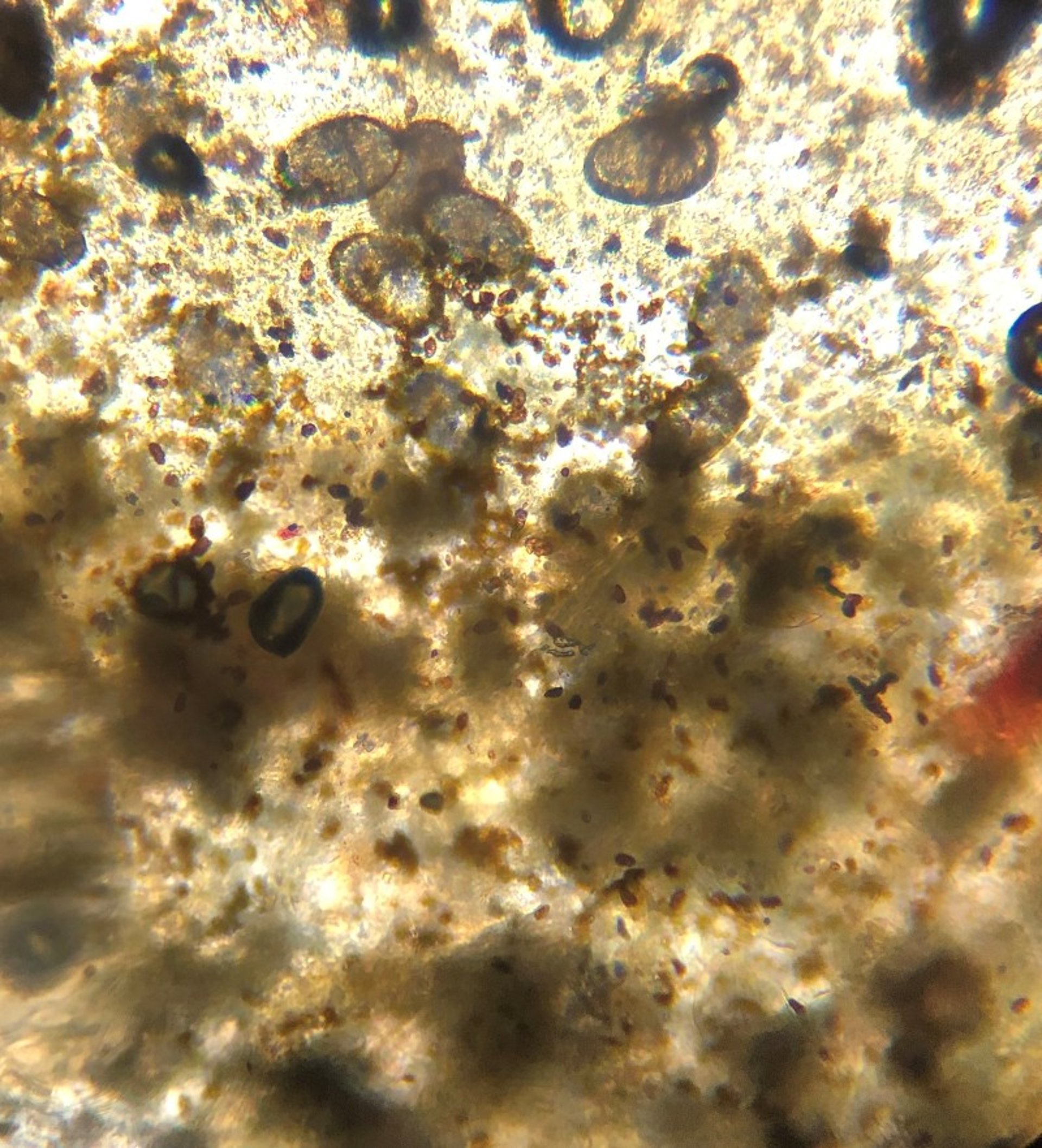
Photomicrograph showing numerous large, ovoid Sarcoptes scabiei eggs and much smaller ovoid, brown fecal pellets (scybala) found on a superficial skin scraping from a dog with severe infestation. Eggs measure approximately 0.10–0.15 mm in length.
Courtesy of Dr. Lara Tomich.
Mites are much easier to find on skin scrapings of cats with notoedric acariasis than on skin scrapings from dogs with sarcoptic mange.
A Sarcoptes antibody ELISA is commercially available in the US.
Diagnosis of psoroptic mange is confirmed by finding Psoroptes mites on a skin scraping or in otic exudate; however, mites can be difficult to find in the ear canal.
Treatment and Control of Mite Infestations Affecting the Pinna
Acaricides
Environmental management
Treatment options for mite infestations include the following:
isoxazolines(afoxolaner, fluralaner [for cats], sarolaner [for cats], lotilaner): Not labeled for scabies treatment but shown to be effective (1, 2, 3, 4). Should be administered orally or topically at label-recommended dosage. Although uncommon, adverse neurological events (eg, muscle tremors, ataxia, and seizures) have occurred with isoxazoline-containing products (5); therefore, caution is necessary in patients with history of seizures.
lime sulfur(safe in all species): 2–4% dips, every 5 days for 4–6 treatments (6)
amitraz (dogs only): dips at a strength of 250 ppm, applied once weekly for 4–6 treatments (7)
ivermectin (dogs and cats): 200–300 mcg/kg, PO or SC, every 1–2 weeks for 3–4 treatments (8). Ivermectin is widely used to treat sarcoptic mange in dogs and has been used to treat notoedric mange in cats; however, it is not approved by the FDA for either indication. Therefore, caution and client education regarding the inherent risks associated with this drug are paramount.
milbemycin oxime (dogs only): Reportedly safe and effective for treating sarcoptic mange in dogs but not FDA approved for this purpose. Recommended dosage: 2 mg/kg, PO, once weekly for 4–6 treatments or twice weekly for 3 weeks (9).
selamectin (dogs and cats): three topical applications as labeled, 2 weeks apart in dogs and cats (10). Heartworm status should be checked before using.
moxidectin (dogs only): Not approved for treatment of sarcoptic mange in the US but approved for topical use in other countries for treatment of sarcoptic mange in dogs. Label-recommended dosages should be followed, and patients should be tested for heartworm before use (6).
Because both Sarcoptes and Notoedres mites cannot survive off of the host for more than a few days, treatment of the environment is usually unnecessary. All animals that have been in contact with an infested animal require treatment, because of the contagious nature of acariasis.
The following dog breeds are particularly susceptible to ivermectin toxicosis:
Collie
Shetland Sheepdog
Australian Shepherd
English Shepherd
Longhaired Whippet
McNab
Silken Windhound
Old English Sheepdog
Before using ivermectin, a genetic test for the mutation of the ABCB1 (formerly MDR1) gene, which encodes for the multidrug transporter P-glycoprotein, should be performed.
Pearls & Pitfalls
|
In pigs, control of sarcoptic mange should focus first on the breeding herd to avoid transmission to the piglets. Treatment is with external acaricide sprays or with an injectable avermectin(ivermectin or doramectin, 300 mcg/kg, SC, once [11, 12]). Dams should be treated 7–14 days before farrowing. Gilts should be treated 7–14 days before breeding. For boars, frequency of treatment varies, depending on exposure; however, it is recommended to treat a minimum of twice a year. Feeder pigs should be treated once before placement in a clean facility.
Eradication programs usually start with culling of all severely infested breeding stock. Simultaneously, two consecutive doses of an injectable avermectin (ivermectin, 300 mcg/kg, SC), 14 days apart (13), should be administered to each pig on the farm. Additional required measures include disposing of infected material (eg, bedding). It is not necessary to treat the environment with an acaricide.
Psoroptic mange in horses and sheep can be treated with ivermectin, 200 mcg/kg, PO, every 2 weeks for two treatments (14, 15, 16). Topical and oral treatments for mange are effective in horses. Only a few compounds are registered for treatment of mange in sheep and goats.
Key Points
Mite infestation should be suspected in any patient with pinnal pruritus and crusting of the pinnae.
Superficial skin scrapings might identify mites, eggs, or feces; patients should be treated even if skin scraping results are negative.
All animals in contact with the affected patient should also be treated for mite infestation.
For More Information
CAPC guidelines: notoedric mite. Companion Animal Parasite Council.
CAPC guidelines: sarcoptic mite. Companion Animal Parasite Council.
Sarcoptic mange. The Pig Site.
Morgan KL. Parasitic otitis in sheep associated with psoroptes infestation: a clinical and epidemiological study. Vet Rec. 1992;130(24):530-532. doi:10.1136/vr.130.24.530
Also see pet owner content regarding mite infestations in dogs, cats, and horses.
References
Chiummo R, Petersen I, Plehn C, Zschiesche E, Roepke R, Thomas E. Efficacy of orally and topically administered fluralaner (Bravecto®) for treatment of client-owned dogs with sarcoptic mange under field conditions. Parasit Vectors. 2020;13(1):524. doi:10.1186/s13071-020-04395-6
Romero C, Heredia R, Pineda J, et al. Efficacy of fluralaner in 17 dogs with sarcoptic mange. Vet Dermatol. 2016;27(5):353-e88. doi:10.1111/vde.12363
Becskei C, De Bock F, Illambas J, et al. Efficacy and safety of a novel oral isoxazoline, sarolaner (Simparica™), for the treatment of sarcoptic mange in dogs. Vet Parasitol. 2016;222:56-61. doi:10.1016/j.vetpar.2016.02.017
Hampel V, Knaus M, Schäfer J, Beugnet F, Rehbein S. Treatment of canine sarcoptic mange with afoxolaner (NexGard®) and afoxolaner plus milbemycin oxime (NexGard Spectra®) chewable tablets: efficacy under field conditions in Portugal and Germany.Parasite. 2018;25:63. doi:10.1051/parasite/2018064
Bates N, Dijkman MA, Edwards JN. Neurological adverse effects of isoxazoline exposure in cats and dogs. Vet Rec. 2024;194(12):e4149. doi:10.1002/vetr.4149
Curtis CF. Current trends in the treatment of Sarcoptes, Cheyletiella, and Otodectes mite infestations in dogs and cats. Vet Dermatol. 2004;15(2):108-114. doi:10.1111/j.1365-3164.2004.00362.x
Folz SD, Kratzer DD, Kakuk TJ, Rector DL. Evaluation of a sponge-on therapy for canine scabies. J Vet Pharmacol Ther. 1984;7(1):29-34. doi:10.1111/j.1365-2885.1984.tb00875.x
Paradis, M. Ivermectin in small animal dermatology. Part II. Extralabel applications. Compendium on Continuing Education for the Practicing Veterinarian. 1998;20:459–469.
Bergvall KE. Clinical efficacy of milbemycin oxime in the treatment of canine scabies: a study of 56 cases. Vet Dermatol. 1998;9(4): 231-233. doi:10.1046/j.1365-3164.1998.00099.x
Six RH, Clemence RG, Thomas CA, et al. Efficacy and safety of selamectin against Sarcoptes scabiei on dogs and Otodectes cynotis on dogs and cats presented as veterinary patients. Vet Parasitol. 2000;91(3-4):291-309. doi:10.1016/s0304-4017(00)00300-9
Chellapandian M, Ramprabhu R, Balachandran S. Treatment of sarcoptic mange with ivermectin in pigs. Indian Veterinary Journal. 2004;81(9):1051-1052.
Arends JJ, Skogerboe TL, Ritzhaupt LK. Persistent efficacy of doramectin and ivermectin against experimental infestations of Sarcoptes scabiei var. suis in swine. Vet Parasitol. 1999;82(1):71-79. doi:10.1016/s0304-4017(99)00003-5
Heinonen M, Bornstein S, Kolhinen R, Saloniemi H, Thovinen V. Eradication of porcine sarcoptic mange within a health declared production model. Acta Vet Scand. 2000;41(1):41-50. doi:10.1186/BF03549654
Soll MD, Carmichael IH, Swan GE, Abrey A. Treatment and control of sheep scab (Psoroptes ovis) with ivermectin under field conditions in South Africa. Vet Rec. 1992;130(26):572-574. doi:10.1136/vr.130.26.572
O'Brien DJ, Gray J, O’Reilly P. Control of sheep scab by subcutaneous injection of ivermectin. Irish Vet J. 1993;46(3):99-101.
Bourdeau PJ. Mites and ticks. In: Robinson NE, ed. Current Therapy in Equine Medicine. 5th ed. Saunders; 2003:187-190. doi:10.1016/B978-0-7216-9540-2.50058-X